

Faerns Foxes are a closed ARPG species of foxes.They are playable by completing quests and events through our discord server.
You will need your own character if you're interested in taking part in it!
Above are buttons which will lead you to specific sections of the ARPG with different information where you can learn more about general lore, character creation and so on!To fully enjoy all features this species has to offer be sure to have a ToyHouse account and join our Discord server!
Before creating your character or purchasing a design with the intention to fully take part in this species, please read the rules that can be found in Creation and Guild as well as our Discord server!All social links are below ↓


Below are a buttons that will take you to specific parts with information about the world, general lore, characters, history and so on!


» Battle at the Meadows Gate
What now exists as the Dead Marshes was not always marshland. Centuries ago, the western reaches of Rūna were dominated by an expansive meadow—open, verdant, and widely regarded as one of the continent's most significant natural thoroughfares. It connected the western coastline to the heart of Rūna in a way that no other route could replicate, and its beauty was considered inseparable from its importance. Travelers passed through it as a matter of course. It was, by all accounts, unremarkable in the way that only genuinely beloved places can be—present, reliable, taken for granted.The battle that destroyed it has no clean name in the historical record. It is referred to most commonly as the Battle at the Meadows Gate, though the gate in question no longer exists and the meadow itself is long gone. What is known is that Faern forces engaged a group of invaders on the western side of the continent—who those invaders were, where they came from, and what they wanted has been lost entirely. The records that might have answered those questions are either destroyed or sealed somewhere in the deeper archives of the Arcanum library, inaccessible to most and apparently of deliberate obscurity. Scholars have noted that this erasure feels less like the natural decay of old records and more like intention, though no one has been able to confirm it.The battle itself was vicious by any account that survives. Magic and steel in combination, the kind of conflict that leaves marks on the land itself. And it did—though not in the way either side anticipated. As the fighting continued, the ground began to shift. Gradually at first, and then catastrophically. The meadow destabilized beneath the weight of the battle being fought across it, sinking into the earth in a collapse that neither army had the presence of mind to notice until escape was no longer possible. The ground gave way. The meadow, and the armies fighting over it, were swallowed into the frigid waters beneath.The survivors were few—those who had been far enough from the epicenter to witness the collapse rather than be consumed by it. Their accounts form the fragmentary basis of what is recorded today, and even those accounts disagree on the specifics. What they share is the image of the meadow simply ceasing to exist, replaced within hours by the cold, waterlogged terrain that has persisted ever since.The grief that followed was collective and lasting. Faern communities across Rūna mourned not only the lives lost but the meadow itself—the loss of a place that had felt permanent. Vows were made. Lessons were declared learned. Time, as it tends to, eroded both the vows and the lessons, until what remained was less history than rumor—a story told in fragments, with the most significant details missing.The Dead Marshes stand today as the only physical evidence that any of it happened. They are not a place Faerns visit by choice. The terrain is treacherous, the atmosphere oppressive in a way that goes beyond the merely physical, and the creatures that inhabit the area are, without exception, things that have been shaped by prolonged proximity to whatever lingers there. The air, travelers report, feels heavy in a way that has nothing to do with weather. Most turn back before they go far enough to find out why.
» First Faerns and The Mist
The oldest question in Faern scholarship is also the one least likely to be answered: where did they come from?The most widely accepted account holds that the first Faerns arrived on Rūna by sea, sailing in from somewhere beyond the continent's current boundaries and making landfall in the western reaches—the area that would eventually become the Dead Marshes, though at the time of their arrival it was still the sprawling meadow it remained for centuries afterward. This account is not supported by any surviving primary record. There are no ship manifests, no settlement logs, no firsthand documentation of any kind. What exists instead are fragments—incomplete references buried in the deeper archives of the Arcanum library, pointing toward some great change or significant event occurring thousands of years ago. The references are damaged, in several cases apparently deliberately so. Whether they describe an arrival, a transformation, or something else entirely is impossible to determine from what remains. Most Faern scholars have quietly concluded that whatever those records originally contained, someone did not want it read.The majority of Faerns engage with this uncertainty by not engaging with it at all. The arrival theory feels true enough, has been repeated long enough, and serves well enough as a foundation story that most see little reason to pull at its threads. A smaller number have made the question a lifelong pursuit, returning repeatedly to the Arcanum's restricted archives in search of anything that might fill the gap. None have succeeded in any meaningful sense. The truth of Faern origins remains exactly where it has always been—just out of reach, and apparently intent on staying there.What has changed, however, is the mist.Rūna was not always an isolated continent. For much of its history the surrounding Frozen Ocean was navigable—cold and difficult, but crossable. The mist that now forms an impenetrable boundary around the island, swallowing anyone who ventures too far into it, is not an ancient feature of the landscape. It is a relatively recent development, at least on geological terms, and it has not stopped moving.The prevailing scholarly theory is an uncomfortable one: the mist is Rūna's response to the Faerns themselves. The continent, in whatever sense a landmass can be said to act with intention, appears to be closing itself off. The mist crept in gradually over centuries, so slowly at first that no single generation could perceive the change. It is only in the accumulated records—sea charts compared across hundreds of years, the accounts of coastal settlements describing open water that no longer exists—that the pattern becomes undeniable. The boundary shrinks. The open sea between the mist and the shoreline grows narrower with every century that passes. The continent is pulling inward, sealing itself away from whatever lies beyond, and the most credible explanation scholars have been able to produce is that Rūna is protecting itself from the influence its inhabitants have had upon it.What that influence was—whether the arrival of the Faerns itself was the catalyst, or something they did afterward, or something still ongoing—is not known. The mist does not offer explanations. It simply advances.The practical consequence is one that Faern leadership is increasingly unable to ignore. At the current rate of encroachment, the mist will eventually reach the coastline. When that happens, Rūna will no longer be a continent surrounded by difficult waters—it will be a continent surrounded by nothing navigable at all, its inhabitants sealed inside with no means of departure and no way to know what, if anything, lies beyond. The question of how to stop the mist—or whether it can be stopped at all—has begun to shift from an abstract scholarly concern to something considerably more urgent. No solution has been found. The mist does not respond to magic in any way that has been successfully documented. It continues, quietly and without apparent hurry, to move closer.
» Golem of Direwood
Beneath the village of Direwood, in the tunnels that most residents preferred not to think about too carefully, a group of necromancers had been working for the better part of a year.Their objective was a golem—not the crude constructs occasionally produced by amateur practitioners, but something definitive. Obsidian-bodied, dark magic at its core, built with the singular intention of being unstoppable. They were not subtle people, and their ambitions were not subtle either. They wanted a weapon, and they believed they had the knowledge to make one. In this, they were half right. They had the knowledge to make it. What they lacked was any realistic understanding of what came after.When the golem was complete it did not wait to be deployed. It rose, assessed whatever passed for its surroundings in that lightless space, and moved upward—through the tunnels, through the cavern ceiling, and into the open air above Direwood with the particular purposefulness of something that has never been told what it cannot do. The necromancers who created it had not accounted for this. The village above them had not accounted for this either, though they had perhaps more excuse—the rumors about activity beneath the village had been vague, and nothing in those rumors had suggested anything on this scale.The golem was, by any measure, extraordinarily difficult to fight. It was large, structurally resilient in a way that conventional weapons could not meaningfully address, and it hit back with a force that cleared ground. For days the Faerns of Direwood threw everything available at it—swords, spears, coordinated magical assault—and wore themselves down considerably in exchange for very little visible progress. The golem did not tire. It did not reconsider. It simply continued.What broke the stalemate was not brute force but observation. A Faern named Lyra, working at the edge of the conflict rather than the center of it, had been watching the golem rather than attacking it—tracking its movements, looking for inconsistencies in its behavior. What she found was a thread. The golem was not autonomous. It was tethered—bound to its creators through a network of dark magic that ran beneath the surface of everything, invisible but present, and serving as the animating connection between the construct and the necromancers sustaining it. Severing that connection would not guarantee destruction, but it would guarantee disorientation, and disorientation was enough to work with.It took considerable effort and more precision than the situation seemed to allow for. But the thread broke.The golem faltered—its movements losing the horrible certainty they had carried for days, its attention fragmenting in a way that made it, for the first time, something that could actually be fought on even terms. The Faerns did not waste the opening. The assault that followed was brief and decisive, and when it was over the golem was rubble—shattered obsidian scattered across the ground in pieces too small and too numerous to reassemble.Direwood survived. The necromancers responsible did not, by most accounts, fare particularly well in the aftermath. The incident was documented, added to the body of evidence already accumulated around the dangers of unsanctioned necromantic practice, and used for years afterward as a cautionary reference in Arcanum teachings. The rubble was never fully cleared. Some of it remains beneath Direwood still, a permanent and largely unacknowledged reminder of what was built down there, and what it cost to unmake it.
» Under the Veil
Leyla was the kind of person Fernwood produced occasionally and never quite knew what to do with—someone too restless for village life but too attached to it to leave properly. She was young, ginger-furred with scattered cream markings, and had a habit of wandering into the pine forest beyond the village's eastern boundary with no particular destination in mind. Most of the time she came back before dark with nothing to show for it but muddy boots and a good mood. Most of the time.The bear was not something she had planned for.She heard it before she saw it—a heavy shifting in the undergrowth that her body understood before her mind caught up—and she was already moving when it rose to its full height behind her. She ran. The forest was dense enough that she had a chance, weaving between trunks and ducking under low branches, and eventually the sounds of pursuit fell away. When she finally stopped, lungs burning, she had no idea where she was.She walked for what felt like hours. The light through the canopy told her the day was getting on, and the temperature was dropping in the way it does in pine forest when the sun loses interest. She was cold, increasingly hungry, and beginning to calculate how badly she had miscalculated the afternoon's excursion when she heard something unexpected—laughter, and beneath it, the faint suggestion of music.She followed it carefully and found three Faerns around a campfire in a small clearing, moving in something between dancing and conversation. They noticed her at the tree line and waved her over without hesitation, and when they saw the state she was in—out of breath, scratched, clearly having had a worse afternoon than most—they brought her to their village without being asked.It was called Veilwood. It was, by any visible measure, lovely. Stone buildings with thatched roofs, window boxes full of herbs, garden plots in full color, animals moving unhurried through the streets. The villagers fed her, found her somewhere warm to sleep, and asked nothing in return. An older woman named Agna took her under her care specifically—sharp-eyed and unhurried, the kind of person who had clearly seen enough of the world to find most of it unsurprising. They talked for a long time. Agna had been lost in these same woods when she was younger, she said, more than once. She promised to help Leyla find her way home in the morning.Leyla explored a little before dark. The village was quieter now, the earlier warmth of the welcome settling into something more subdued. She noticed things she hadn't on arrival—the way conversations stopped slightly too soon when she passed, the way eye contact was held slightly too long. At one point, walking between two buildings, she heard something just behind her left ear. A single word, barely a breath: leave. She turned and found nothing. She told herself it was the wind and almost believed it.She slept in Agna's hut under a thick blanket and went out quickly, more tired than she'd realized.She woke up cold.The blanket had become something else—damp, torn, smelling of rot and age. The hut around her was a ruin: walls sagging, thatch long collapsed, everything soft consumed by mold and time. Outside, what had been a warm and lit village was dark and gutted, every building in the same state of advanced decay. The gardens were gone. The animals were gone. The villagers were gone.Almost.At the far end of what had been the main street, something glowed faintly. She moved toward it before she fully decided to, and when she got close enough to see clearly she stopped. It was a child—small, fox-faced, luminous in the way that had nothing to do with any light source she could identify. And clearly, unmistakably, dead. It turned to look at her.Leyla ran.More of them appeared as she moved—emerging from the ruins on all sides, reaching without urgency, as if they had time. She could hear them behind her, a low murmur of voices asking her to come back, to stay, to stop running. She did not stop running. She made it through the tree line by instinct more than sight, branches catching at her clothes and hair, and kept moving until her legs gave her no other option.She collapsed at the edge of the Lonely Meadows as the sky was beginning to lighten. The open grass and the night breeze and the absence of trees pressing in from all sides was the most relief she had ever felt in her life. She sat there for a while, doing nothing except breathing, before she got up and started walking.Getting home took three more days. She hunted along the way, shifting to her feral form when the terrain made it easier, using her telekinesis to make up for how exhausted her hands were. She thought about Veilwood constantly—about Agna, who had seemed so genuine, and whether there had been something real in her or only a very convincing illusion. About the food she had eaten there, which had never quite satisfied her in the way food should, and which she had not thought to question at the time. About how many other travelers had found that campfire in the woods and followed the laughter to a warm welcome that was not what it appeared to be.Fernwood received her with the particular relief of a community that had begun to quietly fear the worst. She told them everything, clearly and in order, and made sure the relevant details were repeated enough times to stick. Veilwood. The northern edge of the pine forest, past the second ridge. Do not follow the lights. Do not eat the food. Do not stay past dark.She kept exploring after that. She always had. But she learned to pay attention to the feeling of something being wrong, and she learned not to dismiss it when it arrived. That feeling, quiet and easy to rationalize away, had been the only true thing Veilwood had offered her—and it had been right.


» All Faerns
Faerns are a species of anthropomorphic foxes native to the continent of Rūna—bipedal, furred, and unmistakably vulpine in feature. They walk upright on digitigrade legs, their bodies humanoid in structure but covered entirely in fur, with a distinctly animal head: a full muzzle lined with sharp teeth, large pointed ears, and an alert, expressive face that betrays little of the humanity one might expect from creatures of their intelligence. Their hands are five-fingered and dexterous, tipped with short, sturdy claws suited equally to crafting and combat.As a people, Faerns are proud and deeply rooted in tradition. They maintain close ties to the land of Rūna and the creatures that share it with them, drawing on both their environment and their innate magical abilities to sustain their communities. Most live in small, tight-knit settlements nestled near forests, riversides, or lakeshores—modest in scale but rich in culture. Their dwellings are typically timber and stone constructions with thatched roofing, practical in design but often personalized with carvings, painted symbols, or other marks of individual craft.Spirituality is central to Faern life. They hold a deep reverence for the gods of their pantheon and the spirits believed to inhabit the natural world, and much of their daily life is quietly shaped by the effort to maintain balance between the physical and spiritual realms. This isn't performative devotion—it is simply the framework through which most Faerns understand their place in the world.Despite the isolation of many of their communities, Faerns carry significant weight in Rūna's wider ecosystem. Other inhabitants of the continent regard them with a degree of respect born from long observation—their adaptability, collective resilience, and command of magic making them a force that is difficult to ignore or dismiss.Regarding appearance: Faern fur follows strictly natural tones, spanning the full range from snow white to pitch black, with every shade of grey, brown, rust, and cream in between. Markings tend toward the simple—natural patterns inherited from their vulpine ancestry. What they lack in elaborate natural coloration, however, Faerns compensate for through other means: tattoos, body paint, ornate clothing, and in some cases magically dyed sections of fur that would never occur in nature. Coloration also shows a degree of regional adaptation—lighter coats are more prevalent among Faerns from the snowy north and high mountain ranges, while those from dense forests and shadowed meadows tend toward darker fur.
» Types
➵ Faerns - Faerns are the most common classification and form the overwhelming majority of Rūnan society. They are bipedal and humanoid in build, though all Faerns possess the innate ability to shift between their upright anthropomorphic form and a fully feral, four-legged fox form at will. This shift is instinctive and requires no magical training to perform, though younger Faerns may struggle with control during emotionally heightened states. The feral form retains full sapience—a Faern in their four-legged shape is no less themselves than when standing upright. Beyond shapeshifting, all Faerns possess telekinesis: the ability to move and manipulate objects through focused intent alone. This is not considered magic in the traditional arcane sense, but rather a biological trait woven into the species. It sees use in daily life as naturally as one would use their hands—lifting, building, hunting, and crafting. Mind reading is also a latent ability present in all Faerns, though it does not come freely. Both the ability to read another's thoughts and the ability to shield one's own mind must be actively studied and practiced. An untrained Faern is neither a reliable reader nor a well-protected one—their mental defenses are porous and their reach inconsistent. This makes the early stages of development a notable vulnerability, and many communities employ trained Faarns or dedicated instructors to guide young Faerns through the process. Faern lifespans are comparable to those of humans.➵ Faarns - Faarns are a rarer classification, born with a broader and more potent range of abilities than standard Faerns. Their gifts tend to manifest early in childhood—sometimes before the child has the language to describe what they are experiencing—and can include precognition, telepathy, elemental magic, healing, and a variety of other arcane disciplines depending on the individual. Like all Faerns, they are capable of shapeshifting and possess telekinesis. What distinguishes them is the depth and versatility of their magical capacity, and crucially, the accelerated development of their mind reading. Faarns still require training to fully master telepathy, but their natural aptitude means they progress considerably faster than common Faerns—and their mental defenses, once developed, are significantly more robust. An experienced Faarn is difficult to read without their knowledge or consent. Within Faern society, Faarns occupy positions of considerable respect. They are sought as advisors, healers, and leaders, and are typically identified young and placed into structured training programs suited to their abilities. Despite their elevated status, they are held to the same laws and ethical standards as any other Faern. The misuse of telepathy in particular—reading minds without consent, manipulating others through psychic means—is treated as a serious violation, often met with ostracism or formal punishment. Their natural lifespan mirrors that of common Faerns, though magical practice can extend it.➵ Farn-Sol - Farn-Sol are extraordinarily rare, and occupy a category unto themselves. Believed to be direct descendants of the gods, they can only be born into families with established magical lineage. From birth they are distinguished by a taller, broader build than other Faerns, and a pair of feathered wings that emerge in infancy and continue to grow throughout their lifetime. They retain the same capacity for shapeshifting as other Faerns, though their feral form is notably larger than average. Their third eye is active and powerful from birth, and unlike other Faerns, Farn-Sol do not need to learn mind reading—they simply know. The ability is fully developed and instinctive, requiring no training to access. They can read the thoughts of others at will, selectively or broadly, with a precision that trained Faarns rarely match. Their own minds, in turn, are effectively impenetrable to anyone beneath their classification. Only another Farn-Sol can read a Farn-Sol's thoughts, and even then it is no effortless feat. Because of both the power and the potency of their third eye, Farn-Sol customarily wear ornate masks in public—less out of personal preference and more as a practical courtesy, given how unsettling prolonged eye contact with their third eye tends to be for those around them. Farn-Sol are separated from their families at birth and placed into rigorous lifelong training, groomed from infancy for the roles they are expected to fill: kings, high priests, and figures of supreme authority. No Farn-Sol has ever been recorded dying of old age. Whether this constitutes true immortality remains an open question among scholars, as no reliable record of a Farn-Sol's natural death exists.
» Consistent physical features between all types:
➵ Third eye - always present
➵ Long tail - always present but can be styled
➵ Longer fur - can be styled, natural short fur is very uncommon
➵ Body size - average height being between 150cm and 170cm.
» Farn-Sol changes in physical features:
➵ Feathery wings - always present, ranges in size
➵ Body size - average height being 185cm (without wings).
» Magic
Not all Faerns are born with the capacity for magic. Telekinesis and shapeshifting are universal to the species, but the ability to harness and direct arcane power in any meaningful breadth is a trait exclusive to Faarns and Farn-Sol. Those who do possess it find that magic is less a skill to be acquired and more a language to be learned—one with enormous range, but also firm and unforgiving limits.Faern magical tradition is governed by a body of long-standing prohibitions, the most absolute of which is the ban on necromancy. The practice is not merely illegal—it is considered a profound act of blasphemy. Necromancy requires the harvesting of a living being's vital energy, and the reanimation of the dead is regarded as a direct violation of the natural order and an insult to the gods who maintain it. That this prohibition exists does not mean it is universally observed. There are always those willing to pursue forbidden knowledge, and necromancy's allure has never fully disappeared from the darker corners of Rūnan society.Beyond necromancy, a number of lesser magics are also restricted—primarily those that are by their nature uncontrollable, the kind that offer no ceiling on their destructive potential once set in motion. The reasoning is pragmatic as much as it is moral: magic that cannot be stopped should not be started.There is also a hard limit that has nothing to do with law. Every mortal being has a threshold beyond which the channeling of magical energy becomes destructive to the self. Push past it consistently or catastrophically enough, and the mind begins to fracture. Madness is not a rare consequence of magical overreach—it is a well-documented one, and it serves as a natural ceiling on how far any individual can push their abilities.Faarns can access the majority of the arcane spectrum. Their range is broad and, with sufficient training, considerable—but it is not without boundaries. Certain forms of magic remain beyond their reach regardless of skill or dedication, either because the power required exceeds mortal capacity or because the knowledge itself has been lost, sealed, or was never meant for them.Farn-Sol operate under different rules. Their capacity for magic is effectively without parallel among mortal beings—they can harness the full spectrum of the arcane, including forms that no Faarn could safely approach. This does not mean consequence-free. Every use of power at that scale carries weight, and Farn-Sol are trained from infancy to understand that their abilities demand proportional responsibility. The cost of carelessness at their level is not personal—it extends outward.What sets Farn-Sol furthest apart, however, is their access to a category of magic that predates most recorded history. Chief among these ancient abilities is the detachment of consciousness from the physical body—a form of spirit walking that allows a Farn-Sol to project their awareness beyond the boundaries of the mortal realm entirely, traversing parts of Rūna and beyond that no physical form could reach. No Faarn has ever successfully replicated this. No common Faern has come close. For those Farn-Sol willing to push even further, these same ancient methods can allegedly be used to reach toward the gods themselves—though what that encounter looks like, and whether any have truly achieved it, remains unrecorded.Here's a few types of magic Faerns use:
» All Faerns
➵ Telekinetic magic: This type of magic allows Faerns to move objects with their minds or to alter the physical world in other ways.
➵ Telepathic magic: This type of magic allows Faerns to read the minds of others, with drawbacks and limitations.
➵ Shapeshifting magic: This type of magic allows Faerns to shift between their anthropomorphic and fully feral forms.
» Farn-Sol and Faarns
➵ Healing magic: This type of magic is used to cure injuries or illnesses, or to ease pain or discomfort.➵ Elemental magic: This includes magic related to the elements (such as fire, water, earth, and air) and is used to manipulate or control these elements.➵ Enchantment magic: This includes magic that is used to imbue objects with special powers or to change their properties in some way.➵ Illusion magic: This type of magic is used to create false realities or to deceive others.➵ Defensive magic: This type of magic is used to protect Faerns or others from harm, such as by creating magical shields or barriers.➵ Transformation magic: This type of magic allows Faerns to transform into other forms, such as animals or inanimate objects. This type of magic is very very limited.➵ Energy magic: This includes magic related to the manipulation of energy, such as the ability to create and control energy blasts or to absorb and redirect energy.➵ Nature magic: This type of magic allows Faerns to communicate with and control plants and animals, or to manipulate the natural world in other ways.➵ Summoning magic: This includes magic that is used to call forth or summon entities or objects from other planes of existence.➵ Alteration magic: This includes magic that is used to alter one's physical properties or an item's physical properties and more.
» Farn-Sol
➵ Divination magic: This includes magic related to predicting the future or learning hidden knowledge.➵ Ancient magic: This includes magic that is mysterious and ancient, and that is not fully understood by most Faerns. It involves the use of arcane symbols, rituals, or incantations. This includes astral projection or "spirit walking"
» Way of Life
At the core of Faern culture lies a relationship with the natural world that goes beyond reverence—it is structural. Faerns do not simply respect nature; they understand themselves to be part of it, subject to the same forces and balances that govern every river, forest, and living thing on Rūna. The spirits believed to inhabit these places are not distant or abstract figures. They are neighbors, of a kind—ancient presences acknowledged through ritual, ceremony, and the quiet observances woven into daily life. To neglect this relationship is not merely irreverent. To most Faerns, it is simply unwise.This spiritual orientation coexists naturally with a deep appetite for knowledge. Faerns are a studious people by inclination, and the arcane arts occupy a particular place of esteem in their intellectual culture. Those born without magical ability are no less likely to pursue an understanding of it—theory, history, and the documentation of magical phenomena are respected fields in their own right. Magic is regarded as a sacred inheritance rather than a personal asset, and those who wield it—Faarns and Farn-Sol—are held to a standard befitting that weight. Their presence in a community is considered a genuine asset, and their counsel is sought accordingly.Craft holds comparable standing to scholarship. Faern artisans—weavers, potters, woodworkers, metalworkers—are respected figures, and the objects they produce are rarely purely functional. Aesthetics matter. Symbolism matters. Many crafted items incorporate magical elements or iconography drawn from spiritual tradition, blurring the line between utility and devotion in a way that feels entirely natural within Faern culture.Socially, Faerns organize themselves around the family unit, with extended kinship networks forming the backbone of most communities. Leadership tends to emerge from demonstrated wisdom and experience rather than hereditary claim alone—those who lead are expected to have earned it, and to exercise it in service of the community rather than themselves. Disputes are handled through dialogue where possible, with a strong cultural preference for resolution over escalation. This is not naivety—Faerns are fully capable of conflict—but their social code places considerable value on fairness, compassion, and the protection of those who cannot protect themselves.The result is a way of life that is, at its best, quietly cohesive—shaped by a shared understanding of what is owed to the land, to one another, and to the traditions that have carried Faern culture through generations of hardship and change.
» Culture and Hierarchy
Faern culture draws heavily from a legacy of myth, folklore, and spiritual tradition, producing a society that feels simultaneously ancient and living—one where the old ways are not relics to be preserved behind glass, but active frameworks through which daily life is understood and navigated. Regional variation is significant; folk beliefs, local customs, and oral traditions differ considerably between a mountain settlement in Hagālaz and a meadow village in the Lonely Meadows. What remains consistent across all regions is the underlying current of spirituality, the centrality of kinship, and a cultural memory long enough to give even ordinary life a sense of weight and continuity.Architecturally, Faern settlements reflect both their Norse-influenced heritage and the practical realities of their environment. Cities trend toward gothic construction—tall, heavy stonework, arched structures, and a verticality that gives urban centers a dramatic and imposing character. Smaller towns and villages lean toward something older and more grounded: timber longhouse styles, turf and thatch, structures built to weather harsh conditions rather than impress. Both aesthetics coexist without contradiction in Faern cultural identity, representing two different expressions of the same sensibility—one that values permanence, craft, and the visual language of power.Alchemy and other applied magical practices are common throughout Faern society, integrated into commerce, medicine, and craft in ways that make them feel less like specialized disciplines and more like trades. Festivals and seasonal celebrations punctuate the year with regularity, many rooted in folklore old enough that their precise origins have been lost—observed now more out of cultural continuity than any clear doctrinal mandate.Governance follows a tiered structure scaled to the size and complexity of each settlement. Villages and smaller towns are led by elders—individuals whose age, experience, and standing within the community grant them authority by long-established custom. Larger cities operate under formal councils composed of mages, influential figures, and other respected members of the population. These councils function as both legislative and executive bodies, concentrating decision-making authority in the hands of those deemed most capable of wielding it responsibly.Council membership is not inherited. Seats are filled by those who have demonstrated the qualities the community considers essential to leadership—magical ability carries weight, but so does reputation, judgment, and a track record of acting in the interest of the whole rather than the individual. Once seated, council members are expected to uphold a demanding standard of conduct. Their responsibilities broadly encompass the following:Presiding over civic meetings and issuing decisions that affect the city at large. Offering counsel and guidance to community members who seek it. Mediating disputes and administering resolutions in accordance with Faern law and custom. Representing their city's interests in dealings with other settlements or external parties. Overseeing the allocation and development of communal resources. Providing support to those within the community who require it, particularly in times of hardship.Impartiality is the standard to which all council members are held, and failure to meet it is treated seriously. The authority vested in a council is a function of community trust—and that trust, once lost, is not easily recovered.
» Languages
The Faerns communicate with each other using a common tongue that bears resemblance to English, but they also enjoy incorporating words from ancient tongues, reminiscent of Old Norse, into their sentences and names. Unfortunately, much of the knowledge about the ancient tongue has been lost or hidden away in the depths of the Arcanum libraries. However, some words have managed to survive and are still commonly used among Faern communities. It is not uncommon to hear ancient curse words, names, and simple descriptors intermingled with the common tongue.
» Relationships and Social Lives
Faern society occupies an interesting balance between the weight of tradition and a genuine openness to new thought. Reverence for the old ways does not preclude curiosity—if anything, Faerns tend to regard intellectual engagement as its own form of cultural practice. Debate, discussion, and the honest exchange of differing perspectives are considered marks of a well-raised individual rather than signs of dissent. Children are encouraged to question, and adults are expected to listen. This does not always play out neatly in practice, but the ideal is deeply embedded in how Faerns understand themselves as a people.Romantic and familial bonds are treated with comparable seriousness. Many Faerns form lifelong partnerships, and the concept of choosing one person and remaining committed to that choice carries genuine cultural weight. That said, Faern society does not enforce this as a universal expectation—individual circumstances vary, and the broader cultural attitude toward matters of the heart tends toward respect for personal choice over rigid prescription. What is consistent is the expectation of sincerity. Faerns do not take relational commitments lightly, regardless of what form those commitments take.Family structures tend toward the large and extended. It is not unusual for a significant portion of a village's population to share kinship of some degree, with multiple generations living in proximity and maintaining active bonds. The family unit is the primary social safety net in most Faern communities—the first place one turns in hardship, and the foundation upon which broader community trust is built.Beyond their own society, Faerns maintain a carefully considered relationship with the other inhabitants of Rūna. As beings of considerable magical ability and social complexity, they are aware of the position they occupy relative to the rest of the continent's fauna, and they do not take that position lightly. Harm to other creatures is avoided where it can be—hunting and the taking of animal life are practiced only out of genuine necessity, and even then with an awareness of impact on the surrounding ecosystem.Among the non-Faern inhabitants of Rūna, the Raevūr and Rottvārg tribes occupy a particular place of regard. Though more primal in their way of life, both tribes possess magical attributes that place them closer to Faerns on the spectrum of sentient beings, and they are treated accordingly—with respect, and without interference. Faerns recognize in these tribes a connection to the land that mirrors, in its own way, their own spiritual relationship with Rūna.Some Faerns form meaningful bonds with individual animals—companions and familiars that accompany them through daily life. Birds are common in this role, as are various magical creatures whose temperaments make them amenable to partnership. There are even recorded cases of Faerns developing working relationships with Dūrgrim golems, the ancient stone constructs that tend to the mountain ranges—bonds that speak to the Faern tendency to find kinship in unexpected places.When threats do arise from the wilder and more hostile corners of Rūna, Faerns are well equipped to meet them. Defense of community is taken seriously, and the combination of telekinesis, magical ability, and shapeshifting makes even a common Faern a formidable presence when pushed. Hostility is not sought—but it is answered.
» Festivities, Holidays and Special Days
➵ The Harvest FestivalThe Harvest Festival is among the most widely celebrated events in the Faern calendar, observed across villages, towns, and cities alike with a consistency that speaks to how deeply embedded it is in the cultural fabric of Rūna. The specific customs vary by region, but the spirit of the occasion remains the same everywhere it is held—gratitude, community, and the collective acknowledgment that the land has provided.Preparations begin before the day itself. Gathering spaces are dressed with colorful banners, ribbons, and arrangements of harvested produce—less for the sake of decoration than as a visible expression of abundance, a way of making the season's yield tangible and communal. The air in any Faern settlement during the festival carries the mingled scents of ripe fruit, fresh bread, and woodsmoke, a combination that most Faerns associate strongly with home regardless of where they were raised.The festival opens with a procession through the settlement's main thoroughfare. Faerns carry baskets laden with the season's harvest through the streets, accompanied by musicians and the kind of crowd noise that only comes from a genuinely anticipated occasion. The procession ends at the communal gathering space, where long tables are laid and the evening's feast begins to take shape.The feast itself is the centerpiece of the celebration. Dishes are drawn from the harvest—hearty stews, roasted vegetables, freshly baked bread, sweet pastries made from seasonal fruit—and many recipes are ones that surface only at this time of year, passed down through families over generations and carrying the particular weight of things that belong to a specific moment. Eating together, in this context, is not incidental to the festival. It is the festival, or at least the heart of it.Around the feast, the evening fills with activity. Archery competitions and tests of strength draw participants and spectators in equal measure. Carving contests produce work that ranges from the genuinely skilled to the cheerfully amateur. Musicians perform, poets recite, and storytellers hold court—the oral tradition finding one of its most natural settings in a crowd gathered around food and firelight.The spiritual dimension of the festival is woven throughout rather than confined to a single ritual moment. Prayers and blessings are offered to the land and to the spirits of nature across the course of the evening, quietly and without ceremony in some cases, more formally in others depending on local custom. Votive offerings are common—woven wreaths of wheat and wildflowers, small wood carvings, arrangements of produce left at shrines or the bases of significant trees. The underlying intention is consistent: acknowledgment. The land gave, and that is not taken for granted.
➵ The Day of TranquilityThe Day of Tranquility is the most solemn entry in the Faern calendar—a day set aside not for celebration but for remembrance. The recently departed and the long dead are honored equally, the assumption being that the dead do not become less worthy of acknowledgment simply because time has passed. It is observed quietly, and deliberately so. The contrast with the Harvest Festival could not be more pronounced.The day begins in solitude. Faerns rise early and disperse—to groves, clearings, riversides, anywhere that offers stillness and a degree of separation from the noise of daily life. The choice of location is personal, guided by whatever place feels most conducive to genuine reflection rather than any formal requirement. What matters is the quality of attention brought to it. Most spend the morning hours in meditation, allowing memories of those they have lost to surface without resistance. There is no prescribed structure to this private portion of the day. Some sit in silence for hours. Others speak aloud to those they are remembering, in the understanding that the boundary between the living and the dead is considered thinner on this day than any other.As dusk approaches, the solitary observance gives way to the communal one. Faerns gather in the open air—courtyards, fields, the edges of forests—and form circles, hands joined, in a deliberate act of collective connection. The transition from individual grief to shared ritual is considered an important movement, a reminder that loss is not only a private experience. An elder or respected spiritual figure leads the group through the evening's rites, though the specific form these take varies by region and community tradition.Offerings are laid out—candles, flowers, objects that carried meaning to the departed—and prayers are spoken aloud, calling on ancestors and deities by name where names are known. Chants and hymns follow, their cadences unhurried, filling the night air with sound that is less performance than release. It is during this portion of the ritual that spirits are said to emerge. Not in any dramatic or unsettling fashion—they appear as presences at the edge of the gathering, moving quietly among the living, their appearance understood as an expression of reciprocal acknowledgment. The living remember the dead. The dead, it seems, remember back.The Day of Tranquility ends without fanfare. Faerns return home in the small hours, carrying whatever the day gave them—grief processed, memories honored, the particular comfort that comes from having sat with something difficult and not looked away from it.
➵ Festival of LightsThe Festival of Lights does not need much in the way of organization. It announces itself.Once a year, the sky above Rūna transforms after dark—the northern lights unfurl across the heavens in cascading curtains of green, blue, and deep violet, vivid enough to cast faint color across the ground below. It is a natural phenomenon, but Faerns do not regard it as only that. The lights coincide, reliably and without exception, with the emergence of spirits from their hidden reaches of the world. They appear as wisps—small, luminous, drifting—rising up among the stars as the aurora shifts above them. Whether the lights draw the spirits out or the spirits draw the lights down is a question Faern scholars have debated without resolution for generations. Most Faerns consider the question beside the point.Communities gather in open spaces for the occasion—fields, clearings, hilltops, anywhere with an unobstructed view of the sky. The atmosphere is one of collective wonder rather than structured ceremony. There is no elder presiding, no formal sequence of ritual. Faerns simply come together and look up, which feels, on this particular night, like enough. Musicians set up at the edges of gatherings and play through the night, their music unhurried and ambient, shaped to the mood of the occasion rather than driving it. The melodies that work best for the Festival of Lights are the ones that leave room for silence.Throughout the night, Faerns move through the space with an ease that reflects the occasion's lack of formality. Some dance—slow, unperformative movements that echo the drifting of the wisps overhead. Others sit in small groups, talking quietly or saying nothing at all. Offerings are made individually and without announcement: small tokens left on the grass, prayers spoken under one's breath, gestures of gratitude directed toward the lights and the presences moving among them. The spirits themselves keep their distance, drifting at the periphery of gatherings rather than moving through them directly, their proximity understood as acknowledgment rather than interaction.As the night draws toward dawn the lights begin to fade, and the wisps recede with them, returning to wherever it is they spend the rest of the year. The gathering disperses gradually, without any formal conclusion. Faerns make their way home in the early morning quiet, the color of the sky still faintly visible at the horizon. The Festival of Lights leaves no particular obligations in its wake—only the memory of having stood under something extraordinary and felt, for a few hours, that the distance between the mortal world and everything beyond it was not quite as great as it usually seems.
» Architecture
Faern architecture is rooted in Nordic tradition and shaped by the practical demands of the environments Faerns inhabit. The most immediately recognizable features are structural—steeply pitched roofs with broad overhanging eaves designed to shed snow and rain, heavy timber framing, and stonework built to endure rather than impress. Materials are sourced locally as a matter of course: timber from surrounding forests, stone quarried from nearby hillsides, thatch from meadow grasses. The result is construction that feels grown from the land rather than imposed upon it, which is very much the intention.Interior spaces prioritize comfort and functionality in equal measure. Faern homes tend toward open floor plans that allow for easy movement—a practical consideration given that a Faern in their daily life may shift between forms without much forethought, and living spaces are designed to accommodate both without friction. Doorways and ceilings are proportioned for an upright, humanoid build, and furniture follows suit: full-height chairs and tables, sleeping platforms, shelving and storage positioned for hands rather than paws. What distinguishes Faern interiors from purely utilitarian spaces is the attention paid to atmosphere. Large windows and skylights are standard features, flooding rooms with natural light and maintaining a visual connection to the outside world that Faerns are disinclined to give up even indoors. Warmth is a consistent priority—hearths are central fixtures in most homes, and soft furnishings, woven textiles, and layered rugs are common throughout.Communal structures follow the same foundational logic but scaled outward. Gathering halls are built large enough to serve entire communities, their interiors designed around the assumption of regular, collective use. Shrines and spiritual spaces tend toward quieter, more deliberate construction—less ornamentation on the outside, more care taken with the interior atmosphere. Where decorative work does appear, it draws consistently from the natural world: carved fox motifs, intertwining branches and roots, woodland fauna rendered in wood and stone across facades, lintels, and support beams. This ornamentation is not purely aesthetic. In most cases it carries cultural or spiritual significance, functioning as a visual record of belief as much as a design choice.The overall character of Faern architecture—whether a single-room village dwelling or a city's civic hall—is one of purposeful solidity tempered by warmth. Built to last, designed to be lived in.
» Beliefs
Faern spiritual life is anchored by a pantheon of three principal deities, each representing one of the fundamental forces believed to govern all existence. They are not worshipped in isolation—the three are understood as interdependent, each necessary to the function of the others. Creation without preservation decays. Preservation without destruction stagnates. Destruction without creation leaves nothing behind. It is the tension between them, Faerns believe, that keeps the world in motion.
➵ Freyja The Creator - The Creator is a deity that is revered by Faerns as the creator of the world in which they live. This deity is seen as the most powerful and important being in the pantheon and is worshiped as a source of life, creation, and fertility. Faerns believe that the creator is responsible for the creation of the world and all that exists within it, and that it is the source of all life and vitality. They also believe that the creator has the power to shape the world and the events that take place within it, and that it is the ultimate source of guidance and wisdom.➵ Vāli The Preserver - The preserver is a deity that is revered by Faerns as the guardian and protector of the world. This deity is seen as a source of stability and continuity, helping to maintain the balance and order of the universe. Faerns believe that the preserver is responsible for preserving the world and all that exists within it, ensuring that it continues to thrive and grow. They also believe that the preserver has the power to heal and protect, and that it can provide guidance and support to those in need. In their worship of the preserver, Faerns offer prayers, sacrifices, or other forms of devotion in order to honor and invoke this protective deity. They seek out the preserver's guidance and assistance in times of trouble or danger, hoping to receive its protection and support.➵ Hel The Destroyer - The destroyer is a deity that is revered by Faerns as the bringer of change and transformation. This deity is seen as a source of destruction and rebirth, helping to clear the way for new growth and renewal. Faerns believe that the destroyer has the power to bring about the end of things, whether it be the end of a person's life, the end of a way of life, or the end of an era. They may also believe that the destroyer has the power to purify and cleanse, helping to rid the world of negativity and allowing for new beginnings.


» World of Rūna
Rūna is a vast and varied land, home to a diverse array of cultures and landscapes. The climate in Rūna ranges from frozen tundras in the north to warm pine forests and meadows in the south, with a wide range of habitats in between.
In the northern regions of Rūna, the land is covered in snow and ice for much of the year. Faerns who live in these harsh conditions have adapted to the cold, building their homes out of stone and wood to withstand the elements and often using their magical abilities to their advantage by putting up wards to protect themselves. They rely on hunting and fishing to survive, and have developed a deep respect for the land and its fauna. To the south, the climate is warmer and more temperate. Here, the land is green and lush, with rolling hills, forests, and fertile plains. Faerns of this region are farmers and herders, tending to crops and animals in order to sustain themselves. They also trade with other regions of Rūna, exchanging goods and ideas.In the central regions of Rūna, the climate is varied, with everything from mountains to grasslands and forests. Faerns here have adapted to the different environments, developing a range of beliefs and traditions. Some are nomadic, traveling with their herds of animals, while others are more settled, building towns and cities. No matter where they live on Rūna, Faerns of this land are proud and resilient, united by their shared history and values. They are canids who value community and cooperation, and who work together to overcome the challenges of their harsh and varied environment. Rūna is a land of great beauty and diversity, with a rich and complex culture.
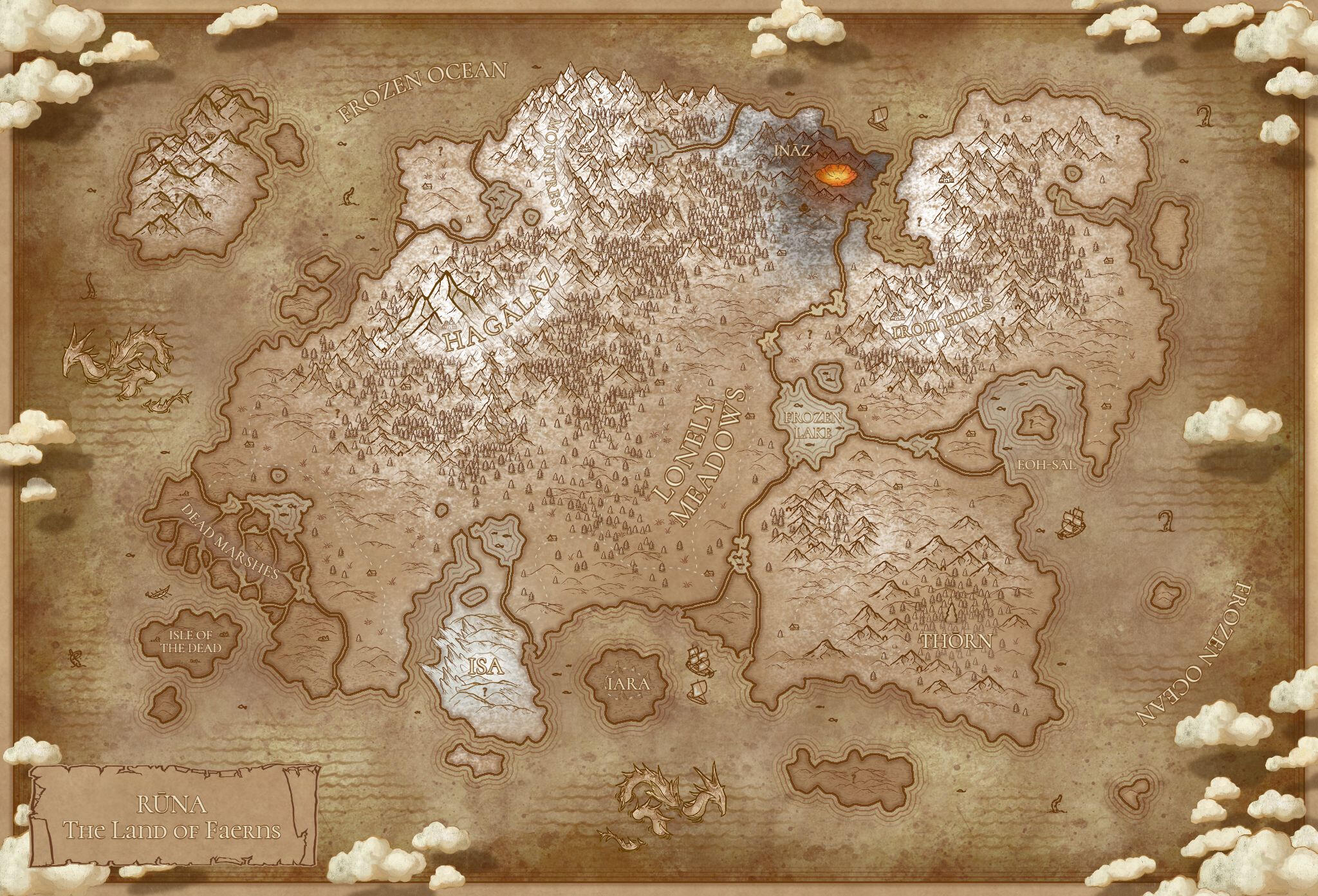
The Frozen Ocean surrounding Rūna itself is surrounded by an impenetrable mist. All who venture there meet their end sooner or later, there has not been any survivors who tried to cross the mist. The ones who turned back described it as a foul place that strips you of the air you breathe the further you go, if you do not turn back you are likely to go mad and suffocate before you manage to cross the mists. Luckily the island is big enough to support the life that thrives there easily enough.Below you can find the map and further the regions!
» Map of Rūna
» Regions
➵ Hagālaz
The biggest mountain range on Rūna also features the tallest peak. It is said to be so tall that it touches the heavens just enough for the gods to be able to descend upon the earth to bless the mortals with their presence. It is too dangerous to try and reach, even for ones with god-like powers. It is often plagued by weird events, flashing lights, terrible weather and magical anomalies. Mortals like to speculate that it's the gods trying to break through the veil into our world, although at the end of the day it is just a magical peak. It is up to those who dare and climb it to decide which is the truth.
The mountain range itself is also very dangerous, freezing with deadly weather at the best of times. The cities built there rely heavily upon their magic to live. While economically it is a very profitable place to build as it is close to all towns on each side of the mountain and the sea, it is not the safest of places to live. Protective barriers are a must.But Hagālaz is more than just a place of physical endurance. It is also a place of spiritual significance, with many Faerns believing that it holds ancient secrets and powerful magic. There are stories of hidden temples and hidden passageways, of hidden treasures and hidden curses.
The mountain range also features an opening, a big gap somewhere cutting through the middle of it. Its origin is unknown though it is not the only gap like that. There is another, almost identical gap in the second mountain range on the other side of Rūna. Passing right through the Iron Hills. It is rumored to have been built by an ancient civilization long ago. There are more landmarks pointing towards that theory being correct.
There is also another place, a very strange place between the sharp peaks of Hagālaz its tail. It is very hard to find. It's a place radiating magic, as if an explosion was frozen in time. Floating rocks as if gravity no longer mattered. An accident long ago that did not go unpunished.
Note: Hagālaz' tail is called Mountrest but it is part of the Hagālaz mountain range. It is very rarely called that.
➵ Iron Hills
The Iron Hills are a mountain range located in Rūna. They are smaller and less treacherous than the towering Hāgalaz mountain range, and are considered to be a much more welcoming and friendly place.The Iron Hills are surrounded by beautiful snowy forests, which are home to a variety of natural fauna such as caribou and snow hares, as well as gorgeous snowy flora. These woods are said to be a fable-like place, with friendly spirits and creatures that are ready to help out any adventurers who come across them.Faerns who choose to settle in the Iron Hills live happy and peaceful lives. The weather is not as treacherous as in other parts of Rūna, and the mountains are not particularly deadly. The Iron Hills are a place of great natural beauty and tranquility, and are a wonderful place to call home.
➵ Lonely Meadows
The Lonely Meadows are a peaceful and idyllic place, surrounded by warm pine forests that serve as a guardian, separating the dangerous creatures of the snowy woods from the friendly life that calls the Meadows home. The Meadows themselves are expansive and open, dotted with wildflowers and grasses that sway in the gentle breeze. The air is filled with the sound of birds singing and the rustling of leaves, creating a sense of calm and tranquility. During the day, the sun shines brightly overhead, casting a warm glow over the Meadows and providing the perfect conditions for the local wildlife to thrive. At night, the stars twinkle brightly in the clear sky, casting a soft light over the landscape.
Vibrant, warm and inviting meadows cover the middle of the island. They are torn up by a few lakes and rivers here and there but are mostly untouched. Beautiful and peaceful, it is often a place Faerns visit to get away from the worries of life. They respect the land, build towns that do not interfere with the fauna and flora of these meadows and the woods surrounding them. Living there feels like a fairytale. The natural wildlife for these are deer, hares, owls, small bears, etc. The spirits and creatures that call these meadows home are often friendly and helpful. All sorts of wisps, fae and specters. Druid Faerns especially love building cottages in the Lonely Meadows. There are lakes and rivers also with plenty of fish to catch. It is the main source of food for Faerns. The water and scenery that comes with it are a sight to behold.
➵ Snowy Forests
The forests surrounding the Hagālaz mountains are very cold and dark places, they are as beautiful as they can be deadly. Not many Faerns settle there. A lot of strange spirits and creatures reside in these forests. Those that can't stand warmth. It is said to be the place where the Isvaarg was first sighted. Among other creatures, some friendly and some viciously deadly. There are many ice spirits there too, they are often very shy. Said to bring good luck if you manage to catch one off guard. If you're very lucky, wisps will appear before you. They lead you to places that are tied to your fate, whether it be good or bad you will only find out if you follow one.
➵ Pine Forests
Warm pine forests are also a very common sight. They surround the Lonely Meadows and stand in between the cold, snowy and dark forests and the peaceful, idyllic, open fields. They often serve as a guardian, to separate the dangerous creatures who roam the snowy woods from the friendly life that calls the Meadows their home. They are also used as hunting grounds, although uncommon, Faerns hunt the local wildlife that lives in these woods, to then feed their families.
➵ Ināz
Ināz is a place of great danger and mystery in Rūna. It is a massive crater that burns with an otherworldly flame, so fierce and intense that it has blackened the surrounding rock and filled the skies with smoke. The area around Ināz is a deadly environment, and it is said that even those who are well-equipped and prepared for exploration risk death if they venture too close to the crater.The flame at Ināz is said to be unnatural and radiates magic, leading many to believe that it is a gateway to the underworld. It is a terrifying sight to behold, and is shrouded in mystery and legend. Many brave or foolhardy adventurers have attempted to explore Ināz and uncover its secrets, but few have returned to tell the tale. Despite the dangers, Ināz is a place of great fascination for Faerns of Rūna. It is a symbol of the power and mystery of the natural world, and many believe that it holds great secrets and treasure hidden within its depths. Despite the risks, some continue to brave the dangers of Ināz in search of knowledge or riches.
➵ Iara
Iara is a small island located in the south of Rūna. It is known for its strange and peculiar nature, and is said to be an ancient ritual site. The island is filled with oddly shaped stones and unique artifacts from a bygone age, and is a place of great mystery and intrigue.
Many Faerns are drawn to Iara for its strange and otherworldly energy, and it is especially popular with those who practice witchcraft. The island is said to be infused with powerful magic, and is a place where Faerns can connect with the spiritual forces of the universe. Despite its small size, Iara is a place of great importance and significance in Rūna. It is a place of mystery and wonder, and is a source of fascination for many Faerns who are drawn to its strange and ancient energy. Whether you are seeking spiritual enlightenment or simply want to explore the mysteries of the past, Iara is a place that is sure to capture your imagination and leave you with a sense of awe and wonder.
➵ Isa
Isa is a treacherous and inhospitable part of Rūna, characterized by icy glaciers and dangerous peaks. It is a place that is avoided by most Faerns, due to the dangers and mysteries that lurk within its frozen depths.Isa is mostly made up of glaciers that point the same way, though the reason for this is unknown. The ice has a strange, magical glow to it, as if it is alive, and the creatures that live in the region believe that it is inhabited by malevolent spirits. Among these is the Nortūr, a spirit-like creature with equine and serpentine features, covered in snow-white scales. It prowls the watery parts of Isa, bringing doom to any ill-prepared adventurers who venture into its territory. Some have mistaken the Nortūr for a dragon, but it is a creature unlike any other, with powers and abilities that are still largely unknown. Despite the dangers and mysteries of Isa, there are still some creatures who call this place home. These are hardy and resilient individuals, who have learned to survive and thrive in the harsh and unforgiving environment. Overall, Isa is a place of great danger and mystery in Rūna. It is a place that is avoided by most Faerns, but is still a source of fascination and intrigue for those who are brave or foolhardy enough to venture into its frozen depths.
➵ Isle of The Dead
The Isle of the Dead is a place of great mystery and danger located in the southwest of Rūna. It is a place that very few Faerns dare to visit, and even fewer have survived the trip. According to the accounts of those who have been there, the Isle of the Dead is a foul and unwelcoming place, filled with death and danger at every turn. The Isle of the Dead is said to be a ruin of an ancient settlement, cursed and abandoned. It is a place that is avoided by most Faerns, as it is believed that those who spend too much time there will go mad, just like in the Dead Marshes. It is also said that the dead walk the earth on the Isle of the Dead, and that it is a place of punishment for those who have done wrong in life. The Isle is a place of great mystery and danger, and is best avoided by those who value their lives. It is a place that is shrouded in legend and fear, and is best left to the imagination of those who are brave enough to venture there.
➵ Dead Marshes
The Dead Marshes are a place of great sorrow and suffering in Rūna. They are an old battlefield, torn up by a long-ago war and left to rot and decay. The marshes are cold, frozen, and dangerous, and are said to be haunted by the vengeful spirits of those who died in battle. It is a place of death and ruin, and is avoided by most Faerns. They are said to be cursed, and those who spend too much time wondering it's wasted land risk going mad. The magic of the Dead Marshes is said to be foul and evil, and it is believed to be a place of great power and danger. Despite their reputation, the Dead Marshes are also a place of great fascination for some. Some Faerns believe that the marshes hold secrets and treasures hidden within their frozen depths, and are willing to brave the dangers in search of them. Others are drawn to the marshes by a sense of curiosity or a desire to understand the suffering and sorrow that took place there.The Dead Marshes are a place of great mystery and danger in Rūna. They are a reminder of the horrors of war and the enduring power of the fox spirit, and are a testament to the resilience and strength of the Faerns of Rūna.
➵ Thōrn
Thōrn is a sacred forest located in Rūna, known for its magical properties and the presence of a large tree at its center. This tree, known as the Tree of Life, is said to be the core building block of the island, and is believed to keep the island alive through its magic. The forest of Thōrn is a place of great beauty and mystery, home to a wide variety of magical creatures such as spriggans, fae, wisps, and spirits. These creatures are said to be friendly and welcoming to those whose intentions are pure, and many Faerns come to the forest to make friends with them and offer gifts to the Tree of Life. The Tree of Life is a massive tree, bigger than any other tree on the island, and it is easy to see from afar due to its lively glow. It is a place of great spiritual significance to Faerns, and many come to Thōrn to worship it and seek healing for their wounds. The forest is said to be accepting of all those whose hearts are pure, and is protected by a mountain range that is difficult to cross. Thōrn is a place of great beauty and spiritual importance in Rūna. It is a place of magic and wonder, and is revered by Faerns and other creatures who call it home.
➵ Frozen Lake
The Frozen Lake is the largest and beautiful body of water located near the center of Rūna. It is the coldest and largest lake on the island, and is known for its stunning beauty and rich variety of fish. Most of the year, the Frozen Lake is frozen over, due to its location in a very cold part of Rūna. Despite the cold, it is a popular destination for fishing, as it has the most diverse range of fish of any body of water on the island. The lake is also a place of great natural beauty, and is often visited by Faerns and other creatures who are seeking a peaceful retreat from the stresses of everyday life. There are several settlements located near the Frozen Lake, which are primarily focused on the trade of fish. These settlements are a hub of activity, with Faerns coming and going to buy and sell the lake's abundant supply of fish. Despite the cold nature of the region, these settlements are generally peaceful and happy places to live, with a strong sense of community and a close connection to the land. The Frozen Lake is a vital part of Rūna's landscape and culture, and is a place of great beauty and prosperity. It is a place that is treasured by Faerns, and is a source of pride and joy for all who call it home.
➵ Coastlines
Rūna is a land of great diversity, and this is reflected in its coastlines as well. The two types of coastlines in Rūna are the frozen coastlines of the north and the warm coastlines of the south.The frozen coastlines of the north are characterized by icy waters, snow-covered beaches, and frozen tundras. These coastlines are home to a variety of hardy creatures that have adapted to the harsh conditions. The Faerns who live along these coastlines rely on hunting, fishing, and whaling to survive, and have developed a deep connection with the sea and the animals that live within it.
The warm coastlines of the south are characterized by sandy/gravel beaches, and crystal-clear waters. These coastlines are home to a variety of animals, including coral reefs, dolphins, and sea turtles. The Faerns who live along these coastlines rely on fishing to sustain themselves, and have a strong connection to the sea and the natural beauty of the region. Both the frozen and warm coastlines of Rūna are important to the Faerns who live there, and both offer their own unique beauty and challenges. They are a testament to the diversity and resilience of the land and its inhabitants, and are an integral part of Rūna's rich and varied culture.
➵ Eoh-Sāl
Eoh-Sāl is a horseshoe-shaped river located in Rūna. It flows through cliffs and loops back into the sea, making it a popular place for ships to drop off cargo and other wares. However, the river is also treacherous for inexperienced seamen, and many ships have been lost in its treacherous waters over the years. There is a town located on one of the cliffs overlooking Eoh-Sāl, called Helmcrest. This town is a hub of activity, with a number of ship docks where ships can stop to refill on supplies and drop off cargo. Helmcrest is an important center of trade in Rūna, and controls the income of cargo on Eoh-Sāl. The town is connected to the river by a series of roads and trails, making it easy for Faerns to move goods between the docks and the town.Eoh-Sāl is an important part of the economy and infrastructure of Rūna. It is a place of great importance to the Faerns of the region, and is a hub of commerce. Despite its dangers, the river is a vital artery of trade, connecting Faerns to the other side of the Island and providing them with the resources and goods they need to thrive.


» Cities
Duskvale and Dawnvale are two twin cities located on Rūna, below is more information on each of them.
➵ Duskvale
Duskvale is a city that never sleeps, with its diverse population of Faerns. Nestled between the jagged peaks of the Hagālaz mountain range, the city is known for its stunning natural beauty. The great lake, the centerpiece of the city, is a sight to behold, with its glimmering waters and magical creatures that call it home. The lake provides water to the entire city, and its properties are said to have healing abilities. Visitors can often see the water sprites dancing and frolicking in the moonlight, and the lake is a popular spot for both locals and travelers alike.
The architecture of Duskvale is a mix of traditional Norse and gothic styles, with tall spires and elegant arches contrasting with the sturdy, functional buildings that line the city streets. The stone buildings are adorned with intricate carvings and detailed embellishments, adding to the city's grandeur. The streets are wide enough to accommodate both wandering Faerns and the occasional enchanted carriage, and the cobblestone paving gives the city a charming, old-world feel. Duskvale's marketplaces are busy with activity, with vendors selling all sorts of goods, from fresh produce and meats to handcrafted items and magical artifacts. The vendors take great pride in their wares and are often seen haggling with potential customers to get the best deal. The marketplaces are located in the heart of the city, and their lively atmosphere is a testament to the city's bustling trade and commerce. The ruling council, led by the Farn-Sol, the highest-ranking leader in the city, is housed in the massive Council Hall, located in the center of the city. The council is responsible for making important decisions that affect the entire city, and their word is law. Duskvale is also home to several magical schools where young Faerns come to learn the secrets of magic. The most prestigious of these schools is the Academy of the Arcane, located on the northern edge of the city. The Academy's library, the Arcanum, is the largest repository of magical knowledge on the continent, and is a popular destination for scholars and researchers from all over Rūna. Duskvale's magical festivals are a sight to behold, with the city coming alive every three months with colorful banners, performers, and magical contests. The festivals celebrate the changing of the seasons and feature dances, feats of skill and magic, and other forms of entertainment. Despite its many wonders, Duskvale is not without its dangers. The mountain range that surrounds the city is treacherous, with harsh weather and dangerous creatures posing a constant threat. As a result, the city is surrounded by a magical barrier that protects it from harm, creating a shimmering dome of energy that can be seen for miles around.
➵ Dawnvale
Dawnvale is a charming twin city to Duskvale, slightly smaller in size but no less vibrant. The city is located in the Iron Hills mountain range of Rūna, nestled in a lush and welcoming environment that is far less treacherous than its twin. Visitors to the city are often welcomed with open arms, and the streets are busy with merchants selling their wares and locals going about their day-to-day business. In terms of size, Dawnvale is slightly smaller than Duskvale, but it makes up for it in charm and character. The city is spread out over a series of winding streets and alleyways, with many of the buildings made out of wood and adorned with intricate carvings and colorful murals. Despite its smaller size, Dawnvale has all the necessary amenities, including marketplaces, taverns, shops, and other such necessities. The city also features enchanting gardens, which are a popular spot for the foxes to relax and read a book. The Faerns of Dawnvale are particularly gifted in the magical arts, and the city is home to several smaller magical schools where young gifted Faerns can learn to control their magic. These schools offer a range of classes, covering everything from basic spellcasting to advanced magical theory. The city also boasts its own Arcanum, which is similar in size and scope to the one in Duskvale. Dawnvale is also home to its own Council Hall, which is similar in design and function to the one in Duskvale. The council hall serves as a hub for the city's government and is where important decisions are made. The city also has several enchanting fountains and wells that provide the inhabitants with water. These magical sources are scattered throughout the city and are an important source of life for the residents. Dawnvale is a city full of charm, character, and friendly inhabitants. The city is bustling with activity, with something for everyone to enjoy. Whether you're looking for a quiet spot to read a book, or a lively marketplace to explore, Dawnvale has it all. Its enchanting gardens, vibrant culture, and laid-back atmosphere make it a must-visit destination for anyone traveling to the Iron Hills mountain range of Rūna.
» Towns
There are about 7 unique towns on Rūna, below is more information on all of them.
➵ Ashencrest
The town of Ashencrest lies at the edge of the ashen wasteland, close to the fiery crater known as Ināz. The air here is heavy, and the ground is scorched and blackened. Despite the inhospitable environment, the Faerns of Ashencrest have thrived thanks to the unique magical properties of the nearby crater. As a result of the intense magical energy radiating from Ināz, Ashencrest is home to a higher concentration of fire mages than most other towns. These skilled Faerns are able to harness the power of the magical fire energy to perform incredible feats of pyromancy, such as controlling flames, conjuring fiery creatures, and even crafting enchanted weapons and tools. The faerns of Ashencrest have developed a unique culture that revolves around their connection to the magical energies of the crater. They hold frequent festivals and ceremonies to honor the power of fire, and many of their buildings and structures incorporate fiery motifs and symbols. Despite the danger of living so close to Ināz, the Faerns of Ashencrest have learned to harness its power for their own benefit. They use the heat from the crater to power their forges, and have developed advanced techniques for working with metal and other materials in the extreme temperatures.
➵ Elmcrest
Elmcrest is a quaint and charming town located to the east of Lonely Meadows on the continent of Rūna. What sets it apart from other towns is the magnificent elm tree that stands tall and proud in the center of the town square. The tree is said to be hundreds of years old and is considered a sacred symbol of the town's history and legacy. The town itself is surrounded by rolling hills and lush greenery, making it a peaceful and idyllic place to live. The Faerns who call Elmcrest home are a friendly and welcoming, always eager to lend a helping hand or offer a warm smile to newcomers. Despite its small size, Elmcrest is busy town, with a vibrant market square where locals gather to sell their wares and catch up on the latest news and gossip. The town is known for its delicious cuisine, with taverns serving up hearty stews, freshly baked bread, and succulent meats. In the evenings, the locals gather beneath the elm tree to share stories and watch the sunset over the hills. It's a serene and magical moment that captures the essence of Elmcrest's beauty and charm. Legend has it that the elm tree was planted by a wise and powerful Faern who foresaw that the town would one day become a haven for all who seek solace and serenity. The tree is said to have magical properties that bring good luck and prosperity to those who gather beneath its branches. Elmcrest may be a small town, but it holds a big place in the hearts of all who call it home. Its rich history and natural beauty have captivated visitors for generations, and it continues to be a beloved destination for those seeking a peaceful respite from the chaos of the outside world.
➵ Helmcrest
Helmcrest, with its strategic location on the cliff overlooking the coast, is the perfect place for merchants and smugglers alike to conduct business. The town itself is built into the side of the cliff, with buildings and homes cascading down towards the sea. From the docks, you can see ships of all sizes and origins coming and going, trading goods of all kinds. Despite the town's reputation for being a haven for illegal activity, there is a bustling market in the town center where legal trade thrives. Traders from all over Rūna come to sell their wares, from spices and textiles to precious metals and gems. But as the sun begins to set, the seedier side of the town emerges. Thieves, cutthroats, and smugglers prowl the streets, looking for easy marks and opportunities to make a quick profit. They are drawn to the town by the promise of riches and adventure, and some even make a name for themselves as legendary pirates or smugglers. Despite the danger, Helmcrest is also a town of sailors and sea lovers. The locals have a deep respect for the sea, and many young Faerns dream of one day joining a crew and embarking on a sea-plundering adventure. The town has its own fleet of ships, crewed by hardy and experienced sailors who brave the open sea to bring back treasures and exotic goods. So if you're looking for adventure, Helmcrest is the perfect place to start. Just be careful who you trust, and keep a close eye on your belongings.
➵ Hillcrest
Hillcrest is a town located near Pitwood, known for its wealthy and noble residents. The town's prosperity is largely due to the income it receives from the nearby mining village of Pitwood, where low-income workers dig for moonsilver and sunsilver. Hillcrest's elite Faerns look down on the inhabitants of Pitwood and consider them mere laborers, despite the fact that Pitwood originated before Hillcrest. The history of Hillcrest dates back to the time of the great Faern Dominions, where noble Faerns were granted land to rule over and protect. The Faern who was granted the land where Hillcrest now stands was known for his cunning and ability to manipulate others to his will. He saw an opportunity in Pitwood and took advantage of it, becoming the middleman between the mining village and the outside world, and taking a share of the profits for himself. Over time, Hillcrest grew in wealth and power, and its inhabitants became more and more entitled. The Faerns of Hillcrest began using Pitwood as a scare tactic to keep their pups in line, threatening to send them to the mines if they misbehaved. The residents of Hillcrest viewed themselves as superior to the miners of Pitwood, and the town and village became bitterly divided. Despite their differences, both the town and village were inextricably linked, and Pitwood's wealth continued to flow into Hillcrest. However, tensions began to rise when the Faerns of Pitwood started to demand better treatment and recognition for their contributions to the town's economy. Hillcrest's ruling Faerns were not willing to relinquish their power and continued to treat the foxes of Pitwood as inferior, leading to a simmering resentment between the town and village. Today, Hillcrest remains a town of wealth and privilege, but the cracks in its foundation are beginning to show. The Faerns of Pitwood are starting to push back against their mistreatment, and it remains to be seen whether the town and village can find a way to coexist peacefully or whether their rivalry will escalate into something more dangerous.
➵ Pinecrest
Pinecrest is a small lumberjack town nestled in the heart of the forest on the continent of Rūna. The town is inhabited by a community of hardy foxes who have built their homes and businesses around the rich resources of the surrounding woodland. The town is surrounded by towering pine trees that stretch towards the sky, providing an endless supply of timber for the skilled lumberjacks. The air is filled with the scent of freshly cut timber, giving the town a rustic and earthy feel. The buildings in Pinecrest are made of sturdy logs and timber, and are adorned with charming details like carved wooden signs and colorful flower boxes. The main street of the town is lined with shops and businesses selling everything from hand-crafted furniture to hearty meals made with ingredients sourced from the forest. Despite being a small town, Pinecrest is a busy town, with lumberjacks coming and going from the nearby forests, transporting logs and lumber to and from the sawmills and woodworking shops that line the streets. The town also boasts a bustling marketplace where residents can buy and sell goods and a cozy tavern where locals gather to swap stories and share a pint of ale. Pinecrest is located near a place called the Lonely Meadows, a quiet and peaceful meadow. It is surrounded by rolling hills and forests, making it the perfect place for a relaxing day out in nature.
➵ Stormcrest
Stormcrest is a small coastal town situated to the north of Duskvale. Despite being a small town, it is famous for its unpredictable and stormy weather, which makes it challenging to navigate for anyone who isn't familiar with the area. The locals are accustomed to the weather patterns and have developed the necessary skills to handle the rough sea conditions. Stormcrest is a pivot point for seafaring folk, who use it as a waypoint for trade and travel along the coast of Rūna. The town's economy heavily relies on trade, and the locals have developed numerous relationships with the traders from other towns. They trade in various goods, including food, textiles, and precious metals. Stormcrest has built a reputation for its high-quality seafood, which is caught by the locals and sold fresh in the local market. Due to the rough weather conditions, fishing is a challenging task, and only the most skilled fishermen can venture out to the deeper waters. Helmcrest, located on the opposite side of the island, is one of the town's closest trading partners. The traders from Helmcrest frequently visit Stormcrest, bringing in new goods to trade and taking back whatever they need. The traders from Helmcrest are particularly interested in the locally caught seafood, which is not readily available in their town. The two towns have developed a close trading relationship, with each town supplying goods that the other town lacks. Stormcrest's location also makes it a popular stop for adventurers and travelers, who often stop by to rest and recuperate from their journeys. The town has numerous inns and taverns that cater to these travelers, providing them with food, drink, and a place to rest their heads. Despite the unpredictable weather, the warm hospitality of the locals makes Stormcrest an attractive destination for anyone looking for a break from their travels.
➵ Suncrest
Suncrest is a bustling trading town that sits atop a large hill in the heart of the Lonely Meadows. It is a hub of commerce and exchange, attracting merchants from all over the continent of Rūna. The town is surrounded by sprawling fields of tall grass and wildflowers, and the distant sound of rushing rivers can be heard in the background. The architecture of Suncrest is a mix of styles, with buildings made of stone, wood, and clay bricks. The winding streets are narrow and steep, with a maze-like quality that can be disorienting for newcomers. Despite this, the town is well-organized and has a lively energy that is infectious. At the center of Suncrest is a large market square where vendors sell goods ranging from fresh produce to rare trinkets and artifacts. The square is always bustling with activity, with merchants hawking their wares and bartering with customers. Surrounding the square are many shops, inns, and taverns, where travelers can rest and refuel after a long journey. Despite its reputation as a center for commerce, Suncrest also has a strong sense of community. The locals are friendly and welcoming, and take pride in their town's success. Many festivals and celebrations are held throughout the year, including the Harvest Festival in the autumn and a midsummer's night celebration. As the town is situated on top of a hill, it offers stunning panoramic views of the surrounding countryside, with rolling hills and verdant forests stretching out in every direction. The town is bathed in warm sunlight during the day and glows with a soft orange hue during the sunset, earning it the nickname "Suncrest".
» Villages
There are about 10 unique villages on Rūna, below is more information on all of them.
➵ Briarwood
Briarwood is a quaint village located in the eastern region of Rūna, nestled between the dense forests of Thōrn to the south and the towering Iron Hills to the north. The villagers of Briarwood are known for their expertise in agriculture, particularly in the cultivation of all types of berries that grow in the nearby forests. The foxes often visit the village to trade for the berries. Briarwood is also home to a small shrine dedicated to the goddess of life and nature Freyja, which serves as a gathering place for the village's druids and other nature-worshipping inhabitants. The village is surrounded by lush greenery, with clear streams flowing nearby and a pleasant, temperate climate. Despite its small size, Briarwood is a welcoming community, with traditional wooden houses and a small marketplace. The Briar Inn is a popular spot for travelers passing through, known for its warmth and delicious food made with fresh local ingredients.
➵ Direwood
Direwood is a small and secluded village located on the edge of a dark and foreboding swamp. The village is surrounded by sparse forests of twisted, gnarled trees, which give the area a haunting and eerie atmosphere. The air is thick with the scent of damp earth and decaying vegetation, and the only sounds that can be heard are the croaking of frogs, the chirping of insects, and the occasional rustle of underbrush. Despite its ominous surroundings, the foxes of Direwood are a hardy and resilient. They have learned to adapt to the dangers of living near the swamp, and have developed a deep respect for the mysterious forces that lurk in the shadows. The village itself is small and rustic, with wooden houses. Most of the buildings are built on stilts, to protect them from flooding during the rainy season. Direwood is known for its skilled hunters and trappers, who brave the dangers of the swamp to collect rare herbs, animals, and valuable treasures. The town's market is filled with strange goods, from rare spices to enchanted talismans. The Faerns of Direwood are also renowned for their folk magic and herbal remedies, which they use to heal the sick and ward off evil spirits. Despite its isolation and its proximity to the swamp, Direwood is a lively place, full of colorful characters and fascinating stories. Whether you're a traveler passing through on your way to other destinations, or a curious adventurer seeking to unravel the secrets of the swamp, Direwood is sure to offer an experience like no other.
➵ Driftwood
Driftwood is an idyllic fishing village, with simple wooden structures that are weathered by the salty air and the relentless sea winds. The village is mostly built on stilts, with homes and businesses rising above the sand and rocks, like a mirage floating above the water. Fisherfaerns return to the village each day with their fresh catch, which is sold at the local small market to residents and visitors alike. The village is peaceful as the fisherfaerns go about their daily business. Despite its humble origins, Driftwood is a flourishing community that takes pride in its work and the bounty that the sea provides. The village is home to a close-knit group of fisherfaerns who have lived and worked together for generations, sharing their knowledge and expertise of the sea. Driftwood is a place of simple pleasures, where the rhythm of the tides and the cycles of the moon dictate the pace of life. The village is surrounded by natural beauty, with the endless expanse of the sea stretching out before it, and the rugged terrain of the eastern coast serving as a backdrop. The village is a place of peace and tranquility, where the stresses of the world are left behind, and the only thing that matters is the rhythm of life by the sea.
➵ Fernwood
Fernwood is a quaint village nestled in the Lonely Meadows, west of Suncrest. The village is surrounded by rolling hills and lush meadows, making it an ideal location for farming. The villagers of Fernwood are hardworking and take pride in their agricultural traditions, which are passed down from generation to generation. The fertile soil and ample rainfall provide an abundance of crops, including wheat, corn, and vegetables. Fernwood is a proud community, with many families living in the same area for generations. The villagers are friendly and welcoming to outsiders, but they are also protective of their way of life. The village is centered around a small marketplace, where locals sell their produce and handmade goods. The village is known for its lively harvest festival just like the neighboring town, which takes place in the autumn and includes feasting, music, and dancing.
➵ Grovewood
The village of Grovewood is a peaceful and serene place, surrounded by forests and streams. The foxes who live here are skilled gardeners and take great pride in the beauty of their flower beds. They spend their days tending to the delicate petals, pruning the leaves, and making sure that their gardens are in perfect condition. The flowers that grow in Grovewood are said to have a unique and enchanting scent that can only be found in this small village. Despite its size, Grovewood is known throughout the region for its exceptional flowers, and many travelers come from far and wide to see the gardens for themselves. The foxes of Grovewood are always happy to show off their handiwork, and they take great pleasure in seeing the joy that their flowers bring to others. Life in Grovewood is simple but satisfying. The foxes live off the land, fishing in the nearby rivers and hunting for game in the surrounding woods. They have a deep respect for the natural world and take great care to ensure that they do not over-harvest or disrupt the delicate balance of the ecosystem. Despite their preference for solitude, the foxes of Grovewood are friendly and welcoming to outsiders. They enjoy meeting new creatures and learning about their customs and traditions. Visitors are often greeted with a warm smile and a fragrant bouquet of flowers, a symbol of the hospitality and kindness that is at the heart of this small village. Grovewood is a reminder that even in a world full of chaos and uncertainty, there are still places of peace and beauty where life is simple and good.
➵ Hallowwood
Hallowwood is a small village nestled deep within a dark and foreboding forest. The trees loom overhead, their branches twisted and gnarled, casting ominous shadows upon the narrow dirt paths that wind through the village. The air is thick with the scent of damp earth and decaying leaves, and a feeling of unease lingers in the air. At the heart of Hallowwood lies a mysterious lake, its waters glimmering with an otherworldly light. The lake is said to be magical, with powers that can curse those who come too close. Its surface ripples with an eerie energy, and strange whispers can sometimes be heard echoing across its shores. The village itself is made up of small, dilapidated cottages that huddle together for protection against the dangers of the forest. The buildings are old and weathered, their wooden frames creaking with age. A few flickering lanterns cast dim light over the muddy streets, illuminating the dark shapes that move in the shadows. Despite its eerie atmosphere, Hallowwood is home to a small but devoted population. The villagers are bound together by their faith in a dark and malevolent deity. They practice strange and unholy rites, sacrificing animals and sometimes even other foxes to appease their god. Visitors to Hallowwood are greeted with suspicion and hostility, and outsiders are rarely welcomed. The villagers keep to themselves, and those who dare to venture too close to the lake risk being cursed or worse. Hallowwood is a place of darkness and danger, a village where the line between the living and the dead is blurred, and where the supernatural holds sway over all who dwell within its boundaries. The nestled lake in Hallowwood is a breathtaking sight, surrounded by towering trees that barely let in any light. Its crystal-clear waters shimmer with a strange blue glow which is the main source of light for the surrounding forest. The lake is fed by a small waterfall cascading down from the mountain behind it. The magic of the lake is undeniable, as many believe it has mystical powers that can corrupt those who dare to touch it. Some say that on certain nights, the lake whispers, luring in those brave enough to seek out its secrets. Despite its enchanting beauty, however, the lake holds a dark history, with rumors of mysterious disappearances and strange happenings surrounding its shores.
➵ Pitwood
Pitwood is a small mining village located in the foothills of a mountain range to the west of Hillcrest. It was founded when miners discovered rich deposits of sunsilver and moonsilver in the surrounding hills. The discovery of these rare metals brought a lot of wealth and prosperity to the village, attracting miners and traders from all over the continent. Despite its wealth, Pitwood has always been seen as a rough and dangerous place due to the dangerous and unpredictable nature of the mines. Accidents and cave-ins are common, and many miners have lost their lives in pursuit of the precious metals. The village itself is linked to the town of Hillcrest. Hillcrest is a much wealthier and more prosperous town, thanks in large part to its relationship with Pitwood. The miners in Pitwood extract valuable metals from the earth, which are then shipped to Hillcrest and used to fuel the town's economy. In return, Hillcrest provides Pitwood with food, supplies, and other necessities. This relationship has made Hillcrest incredibly wealthy, while Pitwood remains a rough and dangerous place with few amenities or luxuries. However, there is also a dark side to this relationship. Many of the wealthy Faerns in Hillcrest look down on the miners in Pitwood, viewing them as nothing more than lowly workers. Some even use the threat of sending unruly pups to work in the mines as a way to maintain control over their children. This has created a deep divide between the two towns, with Hillcrest seen as a place of privilege and Pitwood as a place of toil and suffering.
➵ Shiverwood
Shiverwood is a small village located in the southwestern part of the Rūna continent, nestled deep in the heart of an icy tundra. The village is known for its harsh climate, with temperatures rarely rising above freezing even during the summer months. Despite the unforgiving weather conditions, the foxes of Shiverwood have adapted and learned to thrive in this unforgiving environment. The village is home to some of the toughest and most resilient foxes in all of Rūna. The villagers live off the land by hunting and gathering in the frigid wilderness that surrounds them. They are well-known for their skills in trapping and hunting, and their mastery of the art of tanning and preserving pelts. The village is a hub for the fur trade in the region, and traders from all over come to Shiverwood to purchase the high-quality pelts that the villagers produce. Despite the harsh location, Shiverwood is also known for its hospitality and kindness. Visitors to the village are often welcomed with open arms, and treated to warm meals and cozy lodgings. The village is home to a street of small shops, where traders and merchants come to barter their wares with the villagers. The street is filled with the sounds of haggling and laughter, creating a warm and friendly atmosphere in an otherwise harsh and cold environment. Shiverwood is also home to a small temple dedicated to the god Vāli, where the villagers come to pay their respects and offer prayers for a bountiful hunt or a mild winter. The temple is a beautiful structure made of light stone and icy elements, its intricate carvings and delicate arches a testament to the skill and craftsmanship of the villagers. Despite the challenges of living in such a cold and unforgiving environment, the Faerns of Shiverwood take great pride in their village and their way of life.
➵ Veilwood
Veilwood is a village unlike any other, situated north of the dreaded Dead Marshes. Upon first glance, the village seems to be a thriving and bustling community, with happy Faerns going about their day-to-day lives. But don't let the happy facade fool you, as the village is shrouded in darkness and death. As the day draws on, the villagers welcome any and all travellers with open arms, offering them a warm bed and a hot meal. However, as night approaches, the illusion fades away, revealing the village's true nature. The once-lively villagers are now restless spirits, tormented by the harsh reality of their existence. Their only solace is the torment of any unsuspecting traveller who happens to cross their path. But despite the village's reputation, many adventurers still find themselves drawn to Veilwood, lured by the promise of hospitality and the chance to rest their weary paws. However, they soon discover that the warmth of the villagers' welcome is merely a veil over the darkness that lurks beneath. The village at night is shrouded in an eerie mist that never seems to lift, adding to the ominous atmosphere. The houses are run-down and decrepit, giving off an air of abandonment. The once-bustling marketplace now stands empty, with only the occasional gust of wind rustling the remains of the long-forgotten stalls. Veilwood is a place of death and despair, a place where the veil of illusion is only lifted at night, revealing the true horror that lies within. It is a village to be avoided at all costs, unless one wishes to meet a dark and grisly fate.
➵ Whispwood
Whispwood is a village shrouded in mystery and nestled in the heart of the cold, dense forest at the base of the Hāgalaz mountains. The air is often heavy with fog, creating an eerie atmosphere that seems to have seeped into the very fabric of the village. It is a place where the snow falls early and lingers late, blanketing the landscape in an ethereal white glow. Despite the beauty of the surrounding forests, there is a sense of unease that permeates the village. The few foxes that call Whispwood home are skittish and suspicious of outsiders, often giving travelers a wide berth. It is said that the foxes are the only ones who truly know the secrets of the forest, and that they guard them fiercely. The village itself is small, with winding roads that lead to quaint wooden houses and shops. The buildings are made of sturdy, dark wood that seems to blend seamlessly with the surrounding forest. A quiet stillness hangs in the air, and the only sound that can be heard is the occasional crunch of snow under the paws of the inhabitants. Despite the cold and the pervasive sense of mystery, Whispwood has an undeniable charm. The town is full of magic and wonder, with whispers of ancient spells and fairy tales that have been passed down through generations. It is a place where the lines between reality and fantasy blur, and where the spirits of the forest seem to be lurking just beyond the edge of the trees.


» Svelti's Fields
Centuries ago, a great famine devastated the land and left the Faern of a nearby town starving. With crops failing and no relief in sight, hope was dwindling. But then, a young fox by the name of Svelti appeared in the town. She was said to possess powerful magical abilities, and she promised to help the foxes by creating fields of bountiful crops. Initially, the townsfaerns were hesitant to trust Svelti's claim, but she assured them that if they followed her instructions, the fields would thrive. She instructed them to till the soil in a particular way, plant the seeds in a specific pattern, and sing a special song during the planting process. The Faern followed her every instruction, and before long, the fields were overflowing with a bountiful harvest. Svelti's kindness and magical powers earned the gratitude and admiration of the Faern of the town. They named the fields after her to honor her generosity, and from that day forward, the Svelti Fields became a symbol of abundance and prosperity. Foxes from all over the land traveled there to witness the magical harvest and partake in the abundance. Even after Svelti vanished from the town, the Faern continued to sing her song during the planting process, and the fields continued to produce an abundant harvest year after year. Today, the Svelti Fields remain a place of wonder and reverence, a testament to the power of magic and the resilience of the Faerns.
» Mermaid Cove
Mermaid Cove is a hidden cove that can only be accessed by swimming deep underwater through a narrow passage. It is said to be a magical place with glowing particles all over and crystals decorating its walls. The water is crystal clear, and the sunlight that filters through the water creates an otherworldly ambiance that leaves visitors in awe. The cove is a place for mer creatures to rest and take shelter. Mermaids can often be seen lounging on the rocks and singing their enchanting songs. The creatures of the cove are known for their playful nature and often welcome visitors who are brave enough to attempt the treacherous swim through the underwater tunnel. Many adventurers have attempted to reach the cove, but few have succeeded. The underwater tunnel is long and dark, and it takes a great deal of skill and courage to navigate it successfully. Those who do make it to the cove are rewarded with a breathtaking view of its glittering crystal walls and the magical creatures that call it home. Some say that there are even secrets hidden within the cove's walls, waiting to be discovered by those brave enough to explore them. Whatever the truth may be though, Mermaid Cove remains one of the most enchanting and mysterious places in the world, a place where the beauty of nature and the magic of the unknown come together to create something truly wondrous.
» Sunken Ruins of Erenas
The Sunken Ruins of Erenas, are an intriguing place, located deep beneath the surface of the Frozen Lake. The ruins are said to have once been a great city, with towering buildings, grand temples, and busy markets. However, the city's inhabitants are long gone, and now the ruins lie silent and forgotten, lost to the depths of the lake. The architecture of the ruins is unlike anything seen in todays age, suggesting that they were built by a highly advanced civilization that existed long before the Faerns arrived on Rūna. The ruins are made of a strange, otherworldly material that seems to shimmer and glimmer in the dim light of the underwater environment. The walls of the buildings are adorned with intricate carvings and murals, depicting scenes of a bygone era. The ruins were first discovered by a Faern named Erenas, hence the name, he was a great and renowned researcher from years ago who delved beneath the lakes surface to try and discover its secrets but before he could fully enter, he turned back after feeling an overwhelming sense of dread and danger. Legend has it that the ruins are cursed, and that those who enter them never return. Some say that the spirits of the city's former inhabitants still haunt the ruins, and that they will not suffer the living to disturb their eternal slumber. Others believe that the ruins are home to great treasures and artifacts, hidden away in secret chambers and tombs. Despite the dangers, the Sunken Ruins of Erenas continue to draw adventurers and scholars from all over Runa, eager to explore the mysteries that lie hidden beneath the icy waters of the Frozen Lake.
» Darkwater Lake
Darkwater Lake is a small body of water located north of the Frozen Lake near the village of Grovewood. It is the main source of fish for the village's inhabitants, and is known for its murky and dark waters. The lake is surrounded by dense forests and steep hills, and rumors abound of strange creatures lurking beneath the surface. Despite this, the villagers continue to fish in the lake and rely on its bounty for their survival.
» The Whispering Caverns
The Whispering Caverns are believed to be haunted by a single spirit. This spirit is said to be able to adapt to every person who enters the caverns, whispering to them and attempting to drive them mad with whispers and nightmares that are intensely personal to each individual. Those who listen too closely are said to be driven to madness and despair, consumed by the twisted visions that the spirit conjures up in their minds. Despite the warnings, there are still those who seek out the Whispering Caverns, hoping to uncover the secrets that lie within. But the caverns are treacherous, with twisting passages and sudden drops that can lead to injury or death. And even if one does manage to navigate the treacherous terrain, they must still contend with the malevolent spirit that lurks within, waiting to ensnare the unwary and drive them to madness. Many Faerns believe that the spirit is the ancient deity of madness and secrets, a being that once demanded worship and sacrifice from the foxes of Rūna before being cast out by the other gods. Some even say that the caverns themselves were created by the deity as a prison for its enemies, a place where it could whisper to them and drive them to despair for all eternity. But regardless of the truth, the Whispering Caverns remain a place of mystery and danger, a place where the whispers never cease and the spirit always watches, waiting for its next victim
» The Whispering Falls
The Whispering Falls are a natural wonder that seem to defy the laws of physics. They flow almost silently out of the mouth of the cavern system known as the Whispering Caverns, which run deep under the Hagalaz mountain range. The falls emerge from an entrance deep within the caverns, and their waters cascade down the rocky face with an otherworldly grace. As the falls reach the bottom, they flow into a murky, enchanted lake that is shrouded in mist and surrounded by an impenetrable forest. The light that filters through the trees is dim, and most of the illumination comes from the eerie glow that emanates from the falls and the lake. The area around the lake and falls is steeped in a feeling of ancient magic and otherworldly power. The village of Hallowwood is located nearby, but its inhabitants are strange and unwelcoming, as if the darkness and magic of the Whispering Falls and lake have seeped into their very souls. The falls themselves are eerily quiet, with only the occasional whisper of wind and water breaking the stillness. Yet, there is an unshakable feeling that something powerful and mysterious is at work here, something that can be felt in every whisper and every drop of water that falls from the falls.
» Misty Hollow
Misty Hollow is a place that lies deep within the forest of Faernwood, located in the western region of Rūna. It is a hollowed out tree trunk that stands tall and wide, surrounded by mist and fog that gives it an eerie and mystical feel. The mist and fog are so thick that they obscure the entrance to the hollow, making it difficult to find for those who do not know where to look. Despite its mysterious nature, Misty Hollow is well-known among the Faerns of Rūna as a place of great power. It is said to be inhabited by a spirit that takes the form of a small ghostly squirrel. This spirit is known for granting wishes to those who bring it small sacrifices. It is benevolent and kind, but there is one rule that must be followed: the spirit will only accept forage gathered from the nearby forest and will only grant small wishes. The glow of the fireflies that surround the hollow make it easy to find at night. The fireflies' soft, gentle light illuminates the mist and fog that shroud the tree trunk. As you approach, you can hear the rustling of leaves and the sounds of woodland creatures in the distance. It is as if the entire forest is alive, aware of your presence. As you get closer to the hollow, you may feel a sense of unease or trepidation. This is because the spirit that inhabits Misty Hollow is extremely powerful and demands respect. Those who approach with impure intentions are said to be met with curses and hexes that can have serious consequences. One rule that visitors must remember is that if a bad wish is made upon someone else, that wish is turned into a curse and placed upon the being who made the wish. They will black out and wake up far away from the tree. Over time, the curse will see to fruition, causing great harm to the person who made the wish.
» Deadman's Pass
The Deadman's Pass is a treacherous stretch of water that lies between the Dead Marshes and a small island known as the Isle of the Dead. The waters of the pass are very murky and foggy making it difficult to see more than a few feet ahead. The pass is notorious among sailors, as it is difficult to navigate, and many ships have met their end trying to cross it. The Dead Marshes themselves are already a dark and foreboding place, and the waters of the Deadman's Pass only add to their ominous atmosphere. The mist that hangs low over the marshes also blankets the pass, further obscuring any semblance of visibility. The only thing that can be heard over the lapping of the water against the hull of a ship is the eerie moaning of the wind as it whips through the sails. Many sailors choose to avoid the Deadman's Pass altogether and navigate around the Isle of the Dead if they need to reach the mainland of Rūna. It is said that the waters of the pass are cursed, and that the spirits of those lost at sea haunt its depths, waiting to drag any who dare cross it down to a watery grave.
» Murkwater Bay
Murkwater Bay is a large, murky bay located on the southern coast of Rūna. The water is dark and thick, and the surrounding air is perpetually misty, with a thick fog that hangs low over the bay. The coastline around the bay is rocky and treacherous, with sharp cliffs and hidden shoals that make navigation difficult for all but the most experienced sailors. Despite its inhospitable nature, the bay is a popular spot for ships to dock, especially for those traveling to or from the nearby Island of Iara. The sheltered waters of the bay provide a safe haven from the storms and rough seas of the open ocean. The area around Murkwater Bay is mostly uninhabited, with only a few scattered huts and small settlements located along the coast. However, further north on the continent lies the bustling trading town of Suncrest, which is a major hub of commerce and activity in the region. Many of the goods that pass through Suncrest are transported by ship, and the ships often use Murkwater Bay as a stopping point for rest and resupply before continuing on their journey. And who knows, maybe one day we will find information on the village hidden deep away in the Arcanum library.
» The lost village of Blackwood
The lost village of Blackwood has become a source of fascination for many adventurers and historians who seek to uncover the truth behind its mysterious disappearance. Some have ventured into the Forest of Blackwood, hoping to find any clues or remnants of the village that may have been left behind. However, most return empty-handed, with only stories of strange occurrences and eerie feelings haunting them. There are some who claim to have seen ghostly figures wandering the forest, or heard strange whispers that they cannot explain. Others have reported experiencing intense feelings of unease or even terror when approaching the area where the village was once located. Some even believe that the village may have been swallowed up by some kind of magical vortex or portal, transporting the entire settlement to another realm or dimension. Despite years of investigation and countless theories, the true fate of the lost village of Blackwood remains a mystery. Some believe that it may hold important secrets and knowledge about the arcane and the ancient ways of the Farn-Sol. Others are simply drawn to the thrill of exploring a place shrouded in mystery and intrigue. Whatever the reason, the lost village of Blackwood continues to captivate the imaginations of adventurers and historians alike.
» The Wailing Forest
Located on the west side of Rūna, the Wailing Forest is rumored to contain the remains of the lost town of Frostcrest somewhere in its midst. The forest is an ancient, dense woodland that spans a vast expanse of land. Towering trees loom overhead, their outstretched branches blocking out much of the sunlight and casting long, dark shadows across the forest floor. The ground is blanketed in a thick layer of fallen leaves and twigs, creating a noisy, rustling underfoot that echoes through the trees. The air is thick with moisture and the smell of decay, making it difficult to take a deep breath without feeling choked. Strange, eerie noises can be heard all around, from the creaking of branches to the distant, mournful wails of spirits. As one ventures deeper into the Wailing Forest, the darkness becomes increasingly oppressive, and the sense of being watched and followed more intense. The trees close in on all sides, obscuring the sky and creating a claustrophobic atmosphere that can make it difficult to see more than a few feet in any direction. Travelers who dare to enter the forest are strongly cautioned to stick to the narrow, winding paths that cut through the trees, as straying too far from them can lead to getting lost or, worse, encountering one of the vengeful spirits that seek to punish any who disturb the forest's peace. The forest feels like a place where a malevolent force has taken hold, ready to strike down anyone foolish enough to wander its narrow and confusing paths.
» Abandoned Mines of Pitwood
The abandoned mines of Pitwood are a foreboding place, located deep within the mountain range that dominates the landscape. The tunnels, once bustling with activity, are now shrouded in darkness and silence. The only sounds that can be heard are the distant drip-drip-drip of water echoing through the caverns. Legend has it that the miners who worked in the abandoned tunnels dug into a dark part of the Deep Roads and uncovered something they shouldn't have, unleashing a horror from the depths of the earth. No one knows exactly what it was that they discovered, but the few who managed to escape with their lives spoke of glowing eyes and a sense of unfathomable dread. Since that fateful day, the entrance to the abandoned mines has been sealed, and the area has become a place of fear and superstition. Some say that the creature still lurks in the dark corners of the mine, waiting for unsuspecting victims to wander in. Others believe that the abandoned tunnels are haunted by the ghosts of the miners who lost their lives there. Despite the danger and the rumors, there are some who are drawn to the abandoned mines, seeking adventure or treasure. But those who dare to enter do so at their own peril, for the tunnels are treacherous, and the darkness holds many secrets.
» Craven Hill
Craven Hill is a place of contrasts, where beauty and eeriness collide. As you approach the hill, the ground is covered in vibrant flowers that dance in the breeze. Occasional rocks poke through the soft soil, adding texture to the already picturesque landscape. But as you ascend the hill, something changes. The air becomes still and the colors around you seem to fade away, leaving everything feeling drained. Once you reach the top, the world seems to come to a halt. The silence is deafening, broken only by the sound of your own breathing. In front of you lies a small stone circle, almost entirely covered in flowers. The stones themselves are etched with strange symbols and carvings, hinting at a mysterious history. The uneasy feeling that had been gnawing at the back of your mind suddenly becomes more pronounced, making you want to leave as quickly as possible. From the top of Craven Hill, you can see the ocean in the distance. It's dark and foreboding, seeming to be just as still and quiet as the hill. Despite the uneasy feeling, the place doesn't feel inherently dangerous. It's more like it's been frozen in time, waiting for something to awaken it from its slumber. Visitors to Craven Hill often leave feeling unsettled and unsure of what they just experienced. Some even claim to have seen strange things or felt a presence they couldn't explain. But regardless of whether or not there is any truth to these stories, one thing is for certain - Craven Hill is a place like no other, a place where beauty and eeriness collide in a way that is both haunting and mesmerizing.
» Deadwater Lake
The Deadwater Lake is a big, still body of water that stretches out into the distance located near the Dead Marshes. The lake's waters are murky and dark, making it impossible to see the bottom, and the air around it is always cold and damp. Despite its size, the lake seems almost lifeless, with no fish or other aquatic creatures residing within its depths. The area surrounding the lake is desolate and foreboding, with a thick mist that clings to the ground, obscuring any view of the distant horizon. Strange whispers can be heard in the air, and the spirits of the dead are said to wander the lands around the lake, their forms barely visible through the thick fog. Despite their eerie presence, the spirits seem to always stay just out of reach, fading away whenever someone approaches too closely. The few travelers who have dared to venture near the Deadwater Lake have reported feeling a heavy sense of unease and foreboding, as if the very air around them was suffused with an otherworldly malevolence. Many believe that the lake is cursed, its waters poisoned by dark magic and the spirits of those who perished within its depths. Few are brave enough to linger too long near the Deadwater Lake, as the feeling of being watched and followed by unseen eyes is overwhelming, and the whispers that echo through the mist can drive even the most hardened traveler to madness.
» Black Temple Cavern
The Cavern of the Black Temple is an underground location on Rūna, hidden deep beneath the surface of the continent. It is a place of great mystery and intrigue, accessible only through a series of winding tunnels and passageways. At the center of the Cavern stands a large, black and glowing blue monumental temple. This temple is described as a place of great power and significance, with a presence that is both ominous and awe-inspiring. It is built of shimmering black stone, adorned with intricate carvings and glowing blue runes that seem to pulsate with energy. The Cavern of the Black Temple is a place that is steeped in legend and myth, and is believed to be home to powerful deities or spirits. It is a place where powerful magic is practiced, and where ancient secrets are guarded. Despite its reputation and the dangers that it is rumored to hold, the Cavern is a place that is often sought out by those who are drawn to its power and mystery. The Cavern of the Black Temple is a unique and fascinating location on Rūna. Its underground setting adds to its sense of mystery and intrigue, and makes it a place that is unlike any other on the continent. It is considered to be a part of the Deep Roads.
» Hagālaz and Iron Hills Passageways
The mountains rise up on either side of the passage, their rocky peaks piercing the sky. The passage itself is a wide, jagged crevice that runs through the heart of the mountains, dividing them in half. It was created long ago using ancient magic, and the remnants of that magic can still be seen in the small floating rocks that hang in the air around the passage. These rocks are the remnants of a magical blast that tore through the mountains, splitting them apart and creating the passage. The walls of the passage are rough and uneven, with jagged cliffs and deep fissures. The floor of the passage is rocky and treacherous, with loose stones and uneven footing. Despite these hazards, the passage is a popular route for travelers and traders, as it provides a quick and direct route through the mountains. The passage gives off a very slight, strange glow, an otherworldly aura that can be seen even in the brightest of days. This glow is a reminder of the magic that created the passage, a testament to the ancient power that lies dormant within the mountains. What's even more curious is that there is another passage that is the exact same in shape and properties. It leads through the Iron Hills. Both passages seem to be almost twin-like as if they were created by the same magical explosion.
» The Deep Roads
The deep roads are a vast network of underground tunnels and passageways that stretch across the continent of Rūna. They are believed to have been built thousands of years ago, though no one knows their exact origin or purpose. Some say that they were built by ancient gods, while others believe that they were the work of powerful sorcerers or even otherworldly beings. The deep roads are an endless labyrinth of tunnels, branching off in all directions and leading to a multitude of destinations. Some of the tunnels are wide and spacious, with high arched ceilings and smooth stone walls, while others are narrow and cramped, with rough, jagged walls and low hanging stalactites. The deep roads are filled with countless mysteries and dangers, and it is very easy to get lost in their winding corridors. Despite the dangers, the deep roads are a place of great fascination and intrigue. Many adventurers and scholars have ventured into the deep roads in search of ancient artifacts, forgotten knowledge, and hidden treasures. But few have returned, and those who do often come back with tales of unimaginable horrors and strange, otherworldly encounters. The deep roads are a place of mystery and danger, a place where few dare to venture and even fewer return. They are to this day not fully explored yet, in fact it is believed that Faerns have only explored about 20% of these dangerous passageways.It's difficult to say exactly what kinds of mysteries might be hidden in the deep roads, as they are so extensive that they have not been fully explored and are filled with many unknowns. However, it's likely that the deep roads could hold many ancient artifacts and treasures, as well as hidden knowledge and secrets that have been lost to the ages. It's also possible that the deep roads could contain ancient ruins or other structures that hold clues about the history and origins of the tunnels. Additionally, the deep roads could potentially hold dangerous creatures or other hazards that have remained undiscovered due to the limited exploration of the tunnels. It's clear that the deep roads are a place of mystery and danger, and it's likely that they could hold many secrets and mysteries that have yet to be uncovered that could potentially change the course of life as we know it on Rūna.
» Caves on Rūna
There are many magical and non-magical caves on the island of Rūna. They hide many secrets, artifacts, treasures and dangers. They also sometimes serve as homes to the rat creatures and raccoon goblins. Some caves are bigger than others and some are simple holes in the mountains or the ground that serve as shelter. There are also different kinds of caves, the magical ones that were not made by any rock golems or nature itself but by something more magical. Like they were shaped to be served as settlements but then abandoned. Their now overgrown architecture long lost to time. They're very eerie places to come across by adventurers and alike.
» Frostcrest Town
The town that was once called Frostcrest is nestled in a valley surrounded by rolling hills and dense forests. The ruins of the town's stone buildings stand atop a hill, their crumbling walls and broken roofs illuminated by a soft blue glow. The source of the glow is a magical energy that permeates the town, emanating from a large, circular fountain at its center. The fountain's waters once flowed with life, but now they are still and cold, their surface flickering with blue flames. The streets of the town are overgrown with weeds and vines, and the air is thick with a dense, swirling fog. The fog seems to be drawn to the magical energy emanating from the fountain, swirling around in it. It is said that the fog is the remnants of the magical accident that destroyed the town, a reminder of the terrible power that was unleashed here. This small town is a place of mystery and danger, a haunting reminder of the power of magic and the dangers it can bring. Its ruins are a testament to the fragility of life, and a warning to those who would seek to wield the arcane forces of the world. There are a lot of ruins like these on Rūna. Existing simply as a reminder of how treacherous magic can be.
» The Ring of Fire
The Ring of Fire is a mountain range that circles the sacred forest of Thōrn. It is treacherous and difficult to climb, with steep cliffs and rocky outcroppings that make it nearly impossible for all but the most skilled and determined wanderers to reach the top. Despite its challenges, the Ring of Fire is a place of great beauty, with breathtaking views of the surrounding landscape. The mountains are dotted with small waterfalls and streams, and they are home to a wide variety of wildlife, including owls, bears, and wolves. In the midst of the mountain range, there are natural rock bridges that span deep, dark caverns, providing the only way to cross from one side of the mountains to the other. These bridges are narrow and precarious, and it takes a steady paw and strong nerves to navigate them safely. Many Faerns believe that the Ring of Fire is a test of one's worthiness, and that only those who are pure of heart and determined enough to overcome its challenges are worthy of entering the sacred forest of Thōrn.
» The Cursed Hut
The Cursed Hut is a small, dilapidated structure hidden among the tall pines of the forest. It is covered in cobwebs and has a sagging roof and crumbling walls. The door hangs crooked on its hinges, and the windows are broken. Inside, the hut is dark and musty, filled with the remnants of a life long since abandoned. Cobwebs cling to the rafters, and the floor is cluttered with old, broken objects. The fireplace is cold and empty, and the hearth is blackened with soot. Despite its state of decay, the hut holds many secrets. The walls are adorned with strange symbols and markings, and the shelves are stocked with strange herbs and potions. There are books filled with ancient spells and incantations, and strange, magical instruments scattered throughout the room. It is clear that this was once the home of a powerful and mysterious witch, who practiced her dark arts in secret. As you explore the ruins of the hut, you can't help but feel a sense of unease. The air is thick with the energy of magic, and you can't shake the feeling that the hut is still inhabited by some unseen presence. Whether it be the spirit of the witch who once lived here, or some other dark force, you can't help but wonder what secrets the hut holds and what secrets it has yet to reveal.
» Ancient Gate of Ūhn
The Ancient Gate of Ūhn is a massive stone structure, It is surrounded by tall pine trees and guarded by a pair of stone statues depicting creatures wielding axes. The gate itself is covered in intricate carvings and symbols that seem to pulse with a faint, magical energy. It is believed to be a portal to another realm, one that is shrouded in mystery and danger. Many Faerns wonder what secrets lie beyond the gate, and whether they are brave enough to uncover them. Approaching the gate can be intimidating, as the ancient stones seem to pulsate with a power that is both alluring and intimidating. It is clear that this is no ordinary gate, but rather a portal to a place that holds great power and potential.
» Helheim
Helheim is the island prison to the north-west of Rūna, an ominous structure rising from the island's rocky shore, its jagged walls and turrets jutting into the gray sky. The castle is made of dark, weathered stone, and looks as though it has stood there for centuries, if not millennia. The only indication of its true purpose is the thick, heavy chains dangling from the portcullis, and the faint, otherworldly glow that emanates from the narrow windows near the top of the castle. Descending into the dungeons of Helheim, one must traverse a series of long, winding staircases, each step coated in layers of dust and grime. The air grows damp and frigid, the flickering torchlight casting eerie shadows on the walls. The cells are carved directly into the bedrock, with no windows or source of natural light. The air is thick with the stench of blood, urine, and fear. The illusions that plague the prisoners in Helheim are relentless, constantly shifting and changing. One moment they might be standing in a crowded marketplace, only to find themselves suddenly alone in the dark, their own footsteps echoing off the stone walls. The only guard at Helheim is the powerful Farn-Sol overseer, whose limitless magical abilities make escape from the prison all but impossible. The Overseer is almost omnipresent, able to appear at any location within the castle at any time. His physical form isn't tied to the mortal realm, making him an enigmatic and terrifying character to those who have had the misfortune of being sent to Helheim. It is also considered to be the most secure prison in all of Rūna, and only the most dangerous and irredeemable criminals are sent there. There is no hope of escape, and few ever make it out alive. The prison is a place of darkness and despair, where the only hope is the mercy of the Overseer.
» The Crystal Cove
The Crystal Cove or Crystal Cave is a place of wonder and mystery, located on the eastern coast of the continent of Rūna. It is a cavernous underground world filled with glittering crystals that shine with an otherworldly light, casting eerie shadows on the walls and ceilings. The entrance to the cave is hidden behind a waterfall, and can only be found by those who know the secrets of the surrounding forest. Once inside, the air is cool and refreshing, and the sound of dripping water echoes throughout the passages. The crystals in the cave come in a variety of shapes and sizes, ranging from small, glittering specks to massive pillars that stretch up into the darkness. The light they emit seems to shift and change, casting a colorful spectrum of hues across the cave's walls and floors. The crystals are said to possess powerful magical properties, and those who are skilled in the ways of magic are drawn to the cave in search of their secrets. The passages of the cave are twisty and turn in all directions, making it easy to get lost. Some passages lead to large, open chambers where the crystals are at their most spectacular, while others lead to hidden alcoves and secret rooms where ancient artifacts and magical items can be found. The cave is said to have no end, with new chambers and passages constantly being discovered by those brave enough to explore its depths. Despite its beauty and wonder, the Crystal Cave is not without danger. Strange creatures and magical beings are said to inhabit its depths, and those who venture too far may never return. The cave is also said to be haunted by the spirits of those who lost their way, their ghostly forms seen wandering aimlessly through the passages. Nevertheless, for those who are brave enough to explore its depths, the Crystal Cave is a place of endless mystery and wonder, filled with magic and secrets waiting to be discovered.
» The Arcanums
The Arcanum is a marvel of magical engineering, a towering library of knowledge that serves as the heart of the Academy of the Arcane. The library is a vast labyrinth of corridors and chambers, each one filled to the brim with books, scrolls, and other ancient tomes. The walls of the library are lined with towering bookcases, each one filled with hundreds of volumes, while the floors are covered in thick carpets that muffle the sound of footsteps. The air is thick with the smell of parchment and ink, and the gentle hum of magic can be felt in every corner of the library. Despite its size, the library appears deceptively small from the outside, its unassuming facade giving no hint of the vast repository of knowledge that lies within. Inside, however, the library seems to stretch on endlessly, its twisting corridors leading deeper and deeper into the heart of the building. Each room is a wonder in its own right, with towering bookstands and intricate carvings adorning the walls. The atmosphere in each room seems to change depending on the subject matter of the books within, with some rooms feeling cozy and warm, while others feel cold and austere. The books themselves seem to have a life of their own, with pages flying about and magical bookmarks appearing seemingly out of nowhere. The librarians, dressed in long robes, move about the library with an otherworldly grace, their movements almost too quick to follow. Despite the chaos, however, the library runs like a well-oiled machine, with each book in its proper place and every volume accounted for. The library is enchanted to be much larger on the inside than it appears on the outside, with countless secret chambers and hidden passages leading to even more books and knowledge. The shelves seem to stretch up to the heavens, and the books seem to go on forever. Scholars and researchers from all over the continent come to study at the Arcanum, drawn by the library's reputation as the greatest repository of magical knowledge in the world. The library itself is protected by powerful wards and spells, and only those with the proper authorization are allowed to enter. The first Arcanum is located in the city of Duskvale. There is however, a second Arcanum that is located in the city of Dawnvale. Though it is rumored to be the same one and its entrance is simply enchanted to lead to one specific place no matter from which city you enter. This has given birth to many rumors of the library itself being its own realm rather than a place at the school, to which you are sent to once you pass through its entrance. Whether that is true or not, only the most powerful members of society know the answer to that question.
» The Sunken City
The sunken city on the northern side of Runa, where the Hagalaz mountain range ends, is a place of eerie beauty and haunting mystery. Once a thriving capital, it now lies deep beneath the ocean's surface, its streets and buildings covered in a shroud of darkness that seems to emanate from the very depths of the ocean. The city's name is lost to time, but it is said to have been a place of great wealth and power, with a thriving culture and a sophisticated society. But then something happened - something that caused the ground beneath the city to shake and split apart, sending a portion of the mountain range and the city with it tumbling into the ocean below. Rumors persist that the cataclysm was not a natural disaster, but rather the result of a powerful magical spell gone awry. Whatever the cause, the city now lies abandoned, its once-proud buildings now submerged and slowly being consumed by the ocean's depths. Venturing into the sunken city is a perilous endeavor, and only the bravest and most prepared of adventurers dare to attempt it. The darkness that envelops the city seems almost otherworldly, as if it exists in a realm separate from the mortal world. It is said that even the bravest of sailors feel their courage falter as their ships pass over the sunken city, as if it is trying to pull them down into its depths. Despite the danger, many have attempted to explore the sunken city, seeking treasure, knowledge, or simply the thrill of adventure. But few have returned to tell the tale. The city is said to be cursed, with a palpable sense of death and despair hanging over its ruins. No living sea creature dares to venture near the sunken city, as if they sense the curse that surrounds it. For those who do venture into the sunken city, they will find a place of immense beauty and terrible tragedy. The buildings and streets itself seem to be frozen in time, a silent testament to the once-great civilization that now lies buried beneath the waves. But even as the ruins of the city slowly crumble away, the mystery of what caused its destruction remains unsolved, lost to the depths of the ocean along with the secrets of the past.
» The Maze of Whispers
The Maze of Whispers, located within the Forest of Thōrn, is a labyrinthine network of twisted paths and illusions, the last trial that one must overcome to gain access to the sacred forest. Its name derives from the eerie whispers that seem to surround you, guiding you down false paths and trying to lure you into danger. The maze is an ever-shifting labyrinth that presents a constant challenge to those who enter, with paths changing at will and false trails appearing out of nowhere. The illusions that populate the maze are as varied as they are dangerous, from mirages of tranquil paths to shadowy beasts stalking through the foliage. The whispers that accompany these illusions can drive a person to madness, or worse, lead them straight into the clutches of some malevolent creature lurking in the shadows. Despite its danger, the Maze of Whispers is a vital point of protection for the Forest of Thōrn. Its constantly shifting paths and powerful illusions keep out those who would do the forest harm, and only those who have the strength, courage, and wisdom to navigate its challenges will ever gain access to the sacred realm beyond.


» Council Members
➵ Valdis the Wise
Age: Around 86 years old.
Gender: Male.
Type: Farn-Sol.
➵ Short Description:
Valdis is known as one of the most powerful and respected leaders in all of Rūna. His rule over Dawnvale has brought peace and prosperity to the city and its inhabitants, and his involvement in the ruling council has ensured stability and cooperation among the different Faerns settlements. Valdis is known for his wisdom, kindness, and fairness, and he is always willing to listen to the concerns of his Faerns. He is often referred to as Valdis the Wise. As a Farn-Sol, Valdis possesses incredible magical abilities that he has honed through years of training and practice. He can conjure powerful spells, control the elements, and even summon creatures from other planes of existence to aid him in battle. Despite his immense power, Valdis is humble and dresses modestly, preferring practical clothing that allows him to move freely and quickly when necessary. He has mostly gray fur, with some darker spots that decorate his body. His fur is soft and well-kept, a sign of his status as a ruler. His bright blue eyes are striking and often draw attention, giving him an almost regal air. Despite his power and status, Valdis remains humble and approachable, often taking the time to listen to the concerns of his subjects. His feathery wings, a mark of his Farn-Sol heritage, are impressive in size and add to his majestic appearance. Valdis's path to power was not an easy one, as he had to train tirelessly for many years to reach his current level of mastery. However, his hard work and dedication have paid off, and he is now one of the most respected and beloved leaders in all of Rūna.
➵ Myra the Magnificent
Age: Around 34 years old.
Gender: Female.
Type: Farn-Sol.
➵ Short Description:
Myra is a force to be reckoned with. Her rule over Duskvale is absolute and uncompromising, and she is not one to be crossed. Her piercing gaze and sharp tongue can strike fear into the hearts of even the bravest warriors, and her mastery of magic is unrivaled. She is a true Farn-Sol, born with incredible powers that have been honed through years of dedicated training. Despite her fearsome reputation, Myra is a shrewd and intelligent ruler. She is always thinking several steps ahead, anticipating threats and plotting her next move. She surrounds herself with a small but loyal inner circle of advisors and confidants, whom she trusts implicitly. And as Valdis, she is also part of the ruling council. Myra's dark fur is sleek and glossy, with a few strands of ginger highlights that catch the light. Her large feathery wings are a symbol of her power, and she takes great pride in keeping them well-groomed and perfectly feathered. She favors luxurious, gold-decorated outfits that command attention and announce her authority. Although she is young and relatively new to the role of ruler, Myra has already earned the respect and fear of those around her. She took over after Sol willingly decided to give up the throne. But she is determined to leave her mark on the city of Duskvale, and perhaps one day even the entire continent of Rūna. Due to that she is often called Myra the Magnificent.
➵ Nyx
Age: Unknown.
Gender: Unknown.
Type: Faarn.Intelligence and espionage division.
➵ Short Description:
Nyx is a striking figure, even among the elite mages who make up the ruling council. Their features are defined by sleek black fur that seems to absorb light, and piercing dark brown eyes that convey an air of mystique and danger. They move with a graceful, almost feline gait, and often wear a cloak that conceals their form, adding to their aura of enigma. As a Faarn, Nyx's abilities are formidable, specializing in manipulation magic and shadowy spells that can leave their enemies disoriented and vulnerable. They possess an uncanny ability to disappear into the darkness, making them difficult to track and hunt. Their skillset is vital to the council's ability to maintain order in the land of Rūna, and they are entrusted with the task of neutralizing any rogue mages or other dangerous figures that might threaten the safety of the realm. Nyx's past and true identity remain shrouded in secrecy, and some whisper that they are not even a Faern at all, but a being from another realm entirely. Regardless, their loyalty to the council is beyond question, and their reputation as an uncompromising enforcer of justice and order is widely recognized. Those foolish enough to cross Nyx would be well advised to tread carefully, for their powers can darken the sky at will, and their mastery of manipulation magic can unleash a torrent of horrifying visions that can shatter the mind of any who oppose them.
➵ Amara
Age: Around 47 years old.
Gender: Female.
Type: Faarn.Elemental magic division.
➵ Short Description:
Amara is a powerful and passionate Faarn mage who plays an integral role in the council that rules over Rūna. Their fiery temperament is matched only by their exceptional abilities in the field of pyromancy. Amara was born into a family of blacksmiths and was trained from a young age in the art of metalworking. They quickly discovered their natural talent for fire magic, using it to heat the metal and shape it to their will. Over time, their magical abilities grew, and they began to experiment with more complex spells, eventually mastering the art of pyromancy. Despite their sometimes explosive personality, Amara is fiercely loyal to the council and the foxes of Rūna. They will stop at nothing to protect their homeland and are always willing to put themselves in harm's way to defend it. Amara's knowledge of metalworking has also made them a valuable asset to the council's military efforts, as they are able to craft enchanted weapons and armor imbued with powerful magic. Though some may be intimidated by Amara's fiery nature, those who have earned their trust know them to be a dependable and trustworthy ally. They are willing to go to great lengths to protect those they care about and will not hesitate to use their powers to defend their friends and colleagues.
➵ Sable
Age: Around 51 years old.
Gender: Female.
Type: Faarn.Weather control division.
➵ Short Description:
Sable is a Faarn who controls the winds and the weather. She has a wild and unpredictable personality, but her powers are essential for keeping the continent safe from natural disasters. Sable was born into a tribe of nomadic Faerns and grew up traveling across the lands of Runa. She learned to harness the power of the winds and to communicate with the spirits of nature from her elders. Despite her rough exterior, Sable has a deep respect for the traditions of her Faerns and values the wisdom of the Farn-Sol who sit on the council. She is fiercely independent and often goes against the advice of her fellow council members, preferring to rely on her instincts and intuition. However, when the safety of the continent is at stake, Sable is willing to put aside her differences and work together with the others to find a solution. Sable's fur is a deep, rich brown color, with black tips on her ears and tail. Her eyes are bright green and seem to sparkle with the energy of the winds. She wears a necklace made of feathers and other natural materials, which serves as a reminder of her connection to the spirits of the earth.
➵ Nivala
Age: Around 56 years old.
Gender: Female.
Type: Faarn.Elemental magic division.
➵ Short Description:
The Faarn mage who is part of the council in Duskvale is named Nivala. She is an ice mage, with a natural affinity for controlling and manipulating ice and snow. She is a respected member of the council, known for her cool and logical approach to problem-solving. Nivala comes from a long line of powerful ice mages, and she has trained extensively in the art of ice magic. Her skills are greatly valued by the council, particularly in matters related to climate control and transportation. Despite her reserved and formal demeanor, Nivala is deeply committed to protecting the foxes of Duskvale. She takes her responsibilities as a member of the council very seriously, and is always looking for ways to improve the city and ensure its prosperity. Nivala is also known for her kindness and generosity, particularly towards young mages who are just beginning to learn the art of magic. She is a patient teacher, and is always willing to offer guidance and advice to those who seek it. Nivala is a highly respected and influential figure in Duskvale, and her wisdom and expertise are greatly valued by the council and the Faerns of the city.
➵ Caius
Age: Around 62 years old.
Gender: Male.
Type: Faarn.Defensive magic division.
➵ Short Description:
Caius is a stoic and serious Faarn mage who is a member of the ruling council over the lands of Rūna. His specialty in defensive magic has earned him the respect and admiration of many, as he is responsible for the safety and security of the continent. Caius is a master of creating magical barriers and shields, and is adept at countering curses and spells aimed at his fellow Faerns. Despite his reserved and quiet demeanor, Caius is fiercely loyal to his fellow council members and to the Faerns of Rūna. He understands the gravity of his responsibilities and takes them very seriously, always seeking to improve his craft and stay on the forefront of magical defense. Caius was born into a wealthy and prominent mage family, but he never felt comfortable with their extravagant lifestyle. He witnessed the suffering and struggles of his fellow Faerns, and felt compelled to use his abilities to protect and aid them. He dedicated himself to the study of defensive magic, becoming the most skilled practitioner in all of Rūna. His family disapproved of his chosen path, but Caius was determined to follow his heart and use his talents to make a difference in the world.
➵ Myrion
Age: Around 33 years old.
Gender: Male.
Type: Faarn.Intelligence and espionage division.
➵ Short Description:
Born to a family of Faerns known for their sharp wit and quick thinking, Myrion was always one step ahead of the others. He quickly learned how to use his charm and wit to get what he wanted, whether it was a scrap of food or the attention of an important elder. As he grew older, Myrion realized he had a natural talent for magic. He began to use his skills to further his own agenda, working as a spy for hire and gathering intelligence for various factions across the continent. They became known as a master of deception, able to weave intricate spells of illusion and enchantment to manipulate those around them. Over time, Myrion began to develop a reputation as a cunning and untrustworthy rogue, feared by many and trusted by few. Despite this, he continued to hone his skills, always looking for new ways to gain an edge and protect his own interests. When the council contacted him, Myrion saw an opportunity to gain even more power and influence. He used their charm and magical abilities to gain a seat at the table, and quickly became a valuable member of the council's intelligence network. Now, Myrion uses his talents to protect the continent and ensure that their fellow Faerns remain safe and secure. But he never forgets his roots as a rogue and a trickster, always ready to outwit his enemies and stay one step ahead of the game.
➵ Isadora
Age: Around 44 years old.
Gender: Female.
Type: Faarn.Welfare division.
➵ Short Description:
Isadora was born with a natural gift for healing magic. Growing up in the small village of Fernwood, Isadora spent most of her childhood helping her mother, who was the local herbalist, gather and prepare plants and herbs for their medicinal properties. As she grew older, Isadora's gift for healing magic became more and more apparent, and she began to study under a master healer who taught her how to harness her abilities and use them to heal even the most serious of injuries and illnesses. Isadora quickly became renowned throughout the Faern society for her healing magic, and was often called upon to treat the most serious of cases. Her reputation eventually caught the attention of the council, who recognized the importance of having such a powerful healer on their side. They offered Isadora a position on the council, which she accepted. As a council member, Isadora used her gift for healing to keep the Faern society healthy and free from disease. While she was always willing to use her magic to help those in need, Isadora also had a strong sense of justice, and was not afraid to use her powers to protect Faerns from those who threatened them.
➵ Elenar
Age: Around 56 years old.
Gender: Male.
Type: Faarn.Finance and economy division.
➵ Short Description:
Born into a wealthy merchant family, Elenar was raised with a deep understanding of the importance of economics and the power of currency. He was tutored in all aspects of finance and commerce, from haggling over prices in marketplaces to managing large-scale investments. As he grew older, Elenar's magical abilities began to manifest themselves. He was fascinated with the way that magic could be used to manipulate currency and economics, and devoted himself to learning as much as he could about both magic and commerce. With his dual expertise, Elenar quickly became an invaluable asset to the council. He is responsible for negotiating trade deals, managing the treasury, and overseeing the overall economic health of the continent. Using his magic, he was able to identify and prevent potential economic crises before they could occur, ensuring the prosperity and stability of Faern society. He uses their abilities to create a fair and just economy that benefits all Faerns, not just the wealthy and powerful. And while he may not be the most powerful mage on the council, his knowledge and expertise in economics make them an essential member of the ruling body.
» Important Figures
Characters that hold important positions or have been a part of important events or are in general invaluable to the lore.
➵ Sol
Age: Around 150 years old though no one knows for sure.
Gender: Male.
Type: Farn-Sol.
➵ Short Description:
Sol is a striking figure, with his cream-colored fur, feathery wings, and long elegant tail that swishes behind him as he moves. He is a regal Faern, a Farn-Sol, standing tall and exuding an air of authority that commands respect from those around him. His golden-trimmed outfit is ornate and stylish, with intricate brown leather pieces that complement his fur. The most distinctive feature about Sol is his fancy golden mask, which he wears at all times. It covers most of his face, leaving only his bright, piercing eyes visible. The mask adds to his air of mystery and intrigue, hinting at secrets and hidden motives that lie beneath. Despite his impressive appearance, Sol is a bit of a recluse, preferring to keep to himself and spend his time in the Arcanum library or wandering outside the city. He is known to be very powerful, and his past involvement in the city council only adds to his air of importance. Though he is respected and feared by many, Sol can also be a bit intimidating, with a commanding presence that can make others feel small and insignificant. He speaks little of his past and his reasons for leaving the council, adding to the enigma that surrounds him. Sol's singular focus nowadays seems to be on finding answers to something only he knows. His tireless pursuit of knowledge and understanding seems to consume him completely, driving him to spend countless hours locked away in the Arcanum library or out in the world endlessly searching for answers.
➵ Aeluriel the Seer
Age: Around 47 years old.
Gender: Female.
Type: Faarn.
➵ Short Description:
Her name is Aeluriel, which means "sight of the heavens" in the old runic languages found on some abandoned ruins scattered throughout the land. Aeluriel was born into a family of Faarns who served the ruling council of Duskvale. From a young age, she showed signs of having a unique gift for seeing into the future, which caused a mix of fear and fascination among those who knew of her abilities. As she grew older, her gift became more powerful and unpredictable, and it was decided that she should be taken into the care of the council for her own safety and for the good of the city. Despite the restrictions on her life, Aeluriel has managed to find solace in her ability to glimpse into the future. She spends most of her time in quiet meditation, waiting for the visions to come. When they do, they often come with a great intensity, overwhelming her senses and leaving her drained and disoriented. However, she knows that the council relies on her and she is determined to use her gift to help the city and its foxes. Aeluriel's gift is a mystery even to herself, usually only the Farn-Sol have the ability to glimpse into the future. Unlike the Farn-Sol however, they are involuntary. Her blindless is a side effect of her abilities but to Aeluriel, it simply is what it is, and she has learned to rely on her other senses to navigate the world around her. Despite her isolation and the fear that surrounds her, Aeluriel remains a kind and compassionate soul, always seeking to help those in need. Her name, which means "sight of the heavens" in the old runic language, is a reflection of her deep connection to the spiritual realm and her belief that her gift comes from a higher power.
➵ Aksha Redwood
Age: Unknown.
Gender: Male.
Type: Rumored to be a Faarn.
➵ Short Description:
Aksha Redwood is a Faern mercenary whose reputation precedes him. With his dark brown fur and striking ginger highlights, he cuts an imposing figure that suggests he is not to be trifled with. He takes great care to maintain his threatening appearance, knowing that it helps him secure contracts and intimidate his enemies. Aksha is always clad in black attire, often adorned with gold accents that serve to highlight his impressive physique. His personality is characterized by a dry, biting sarcasm that can catch others off guard, yet few can deny that he is an expert in his field. Despite his formidable reputation, Aksha is a very private individual, and no one knows much about his past before he became a mercenary. Aksha has earned the respect and trust of many, and he is often called upon to complete difficult or dangerous tasks that others cannot. Even by the council at times. His prices reflect that as he ALWAYS gets the job done. His preferred weapon is a blade, but many whisper that he must possess magical abilities to be so successful in his line of work. While he does not reveal much about his personal life, Aksha is known to enjoy spending time in taverns and inns, where he regales anyone who will listen with tales of his exploits and adventures.
➵ Ameridian
Age: Unknown.
Gender: Male.
Type: Faarn.
➵ Short Description:
Ameridian is a tall and imposing figure, with a mix of black and dark gray fur that blends in perfectly with the shadows of the forest. His striking white war paint, which encircles his eyes, nose, and back, stands out sharply against his dark fur. His most distinctive feature, however, is his left front leg, which is ghostly and translucent, with white glowing bones visible beneath the surface. The limb is the result of a tragic magical accident that nearly claimed his life. Ameridian is a recluse, living alone deep in the woods beneath the Hagālaz mountain range. Few dare to venture near his domain, for he is a great mage and not afraid to dabble in the dark arts for his own benefit. He is a master of many forms of magic, including those that involve the manipulation of shadows and darkness. He is known throughout the Faern community as one of the most powerful mages on the continent of Rūna. Ameridian was not always a recluse though. In his youth, he was a brilliant student at the magical academy in Duskvale, where he learned everything there was to know about magic. However, a tragic incident forever changed him. It involved a botched attempt to capture a dangerous mage gone rogue, which resulted in the death of a family that included someone who was very close to Ameridian. The council did their best to cover up the incident, but it left a deep wound on Ameridian's soul. From that point on, he became cold and aloof, and shortly thereafter, he left the city for good.
» Notable Characters
Characters that are not as important but still worth mentioning and interesting.
➵ Calico Jack
Age: Immortal due to his curse.
Gender: Male.
Type: Faern.
➵ Short Description:
Calico Jack is a Faern who was once a sailor, but was cursed to wander the seas forever. He's tall and lean, with sleek, silver fur with brown and black spots that shimmers in the moonlight. His eyes are a deep green, filled with a mix of sadness and determination. He wears a tattered black coat and a worn tricorn hat, both remnants from his past life as a sailor. Calico Jack's curse has taken a toll on him, both physically and mentally. He's often tired and hungry, as he can never stay in one place for too long. His once-sharp senses have dulled over the years, making him more vulnerable to danger. However, he's also developed a keen sixth sense, which helps him navigate through treacherous waters and avoid dangerous sea creatures. Jack is determined to find a way to break his curse. Due to it he is also immortal, he cannot die no matter how hard he tries to. Every time he seems to regenerate almost instantly. He cannot step on land either, every time he does after a few moments he seems to lose consciousness and wake back up on his ship. He has stopped many ships in hopes of finding someone who will help him break it and has consulted countless spirits and deities. So far no luck. However, he remains hopeful that one day he'll find a way to break the curse and be able to finally rest his weary soul.
➵ Kaelin Sunseeker
Age: Unknown.
Gender: Male.
Type: Faarn.
➵ Short Description:
Kaelin is a light gray Faarn with gray-green eyes. He has dedicated his life to healing the sick and wounded, traveling from town to town to offer his services to those in need. His magic is powerful, and he has saved countless lives over the years. Despite his kindness and compassion, Kaelin is haunted by a dark secret from his past. He rarely speaks of it, and those who know him well understand not to ask. But the memory of what happened still lingers, and he struggles to reconcile it with his desire to help others. Kaelin is a solitary figure, preferring to keep to himself when not attending to his duties as a healer. But despite his reserved nature, he has a calming presence that puts those around him at ease. He is deeply spiritual and often spends hours meditating or communing with nature in quiet contemplation. While Kaelin is highly respected for his skills as a healer, there are some who fear him and whisper rumors about his past. They whisper that he was involved with the council many years ago, for what reason he never says but it didn't seem to be a good one considering how secretive he is about it. But he tries not to let it bother him, knowing that his work speaks for itself. But there are times when the weight of his secrets feels almost unbearable, and he wonders if he will ever truly be able to leave them behind.
➵ Lyra Bristlefur
Age: Around 26 years old.
Gender: Female.
Type: Faarn.
➵ Short Description:
Lyra is a young Faarn with long, dark fur, a tail typically braided and piercing green eyes. She was born and raised in a small village nestled deep in the forests of Rūna, where her natural aptitude for magic was recognized early on by her parents who encouraged her to develop her talents. Under the tutelage of the village's elder mage, Lyra learned to harness the elements and control the forces of nature. But tragedy struck when a powerful curse swept through the land, causing the trees to wither, the animals to sicken and die, and ultimately claiming the lives of her family and fellow villagers. Despite her valiant efforts, Lyra was unable to save anyone except herself. Haunted by the memory of the curse and her perceived failure, Lyra left her village and embarked on a journey of self-discovery. Along the way, she met other mages who taught her new spells and honed her magical abilities. It was during her travels that she stumbled upon the village of Direwood, besieged by an undead golem. Without hesitation, Lyra stepped forward to assist the villagers, using her magic to weaken the golem and allowing the others to finish it off. Her courage and battle prowess won her the respect and admiration of the grateful villagers, cementing her status as a local hero.
➵ Captain Blacksnout
Age: Around 67 years old.
Gender: Male.
Type: Faern.
➵ Short Description:
Blacksnout is a pirate whose reputation precedes him wherever he goes. His black fur is shaggy and unkempt, and his sharp teeth gleam in the light, earning him his infamous name. He stands tall and lean, with a muscular frame that speaks to his physical prowess as a pirate. His eyes are a piercing gray, and he has a menacing glare that sends shivers down the spines of his enemies. Blacksnout's clothing is adorned with various trinkets and accessories that he has collected during his many plundering expeditions. He wears a long, tattered coat that is stained with saltwater and blood, and a large hat that casts a shadow over his face, further enhancing his menacing appearance. His weapons of choice are two long, curved cutlasses that he keeps strapped to his sides at all times, and he is skilled in using them in combat. Blacksnout is known for his ruthless tactics and his willingness to do whatever it takes to get what he wants. He is a master strategist who can outwit even the most cunning of opponents, and he is not above resorting to underhanded methods to achieve his goals. Despite his fearsome reputation, Blacksnout is fiercely loyal to his crew, and he will do anything to protect them. His unsuccessful attempt to cross the mist that surrounds the continent of Rūna is seen as a testament to his bravery and recklessness. Though he lost all of his crewmates in the attempt, Blacksnout returns to Helmcrest a changed man, haunted by the loss of his friends and determined to make his mark on the world of piracy even more indelible than before.
➵ Riven Raincatcher
Age: Around 32 years old.
Gender: Female.
Type: Faern.
➵ Short Description:
Riven the Explorer is a striking figure with her pure white fur, which stands out against any background. She is lean and agile, with a muscular build honed through years of adventuring. Her piercing blue eyes constantly scan her surroundings, always on the lookout for new opportunities or potential dangers. Riven is a skilled fighter, adept with both sword and bow, and has honed her telekinetic abilities to use them both offensively and defensively in battle. Despite her adventurous nature, Riven is also incredibly intelligent and has a sharp mind for puzzles and riddles. She enjoys the challenge of solving complex mysteries and uncovering hidden secrets, often leading her to remote or dangerous locations. Her travels have taken her to the furthest corners of the continent, and she has amassed a vast knowledge of geography, history, and cultures. Riven is independent and self-reliant, preferring to work alone or with a select few trusted allies. She is quick to trust those who have proven themselves to be loyal and dependable, but just as quick to dismiss those who show themselves to be untrustworthy or unreliable. Her loyalty lies with her own sense of adventure and discovery, but she is not above lending her skills to worthy causes or helping those in need.
➵ Lirien Everbloom
Age: Around 23 years old.
Gender: Female.
Type: Faarn.
➵ Short Description:
Lirien is a lithe and graceful Faarn with sleek, dark fur that seems to shimmer in the light. Her light blue eyes are framed by thick lashes, and she has a small, elegant snout. She wears flowing garments made of soft, colorful fabrics that swirl around her as she moves, and she carries a lute with her at all times. Her magic dances across the strings with ease, and her voice is rich and melodious, captivating her audiences with every note. In addition to her musical talents, Lirien is a gifted storyteller. She weaves intricate tales of adventure and romance, drawing her listeners in with her vivid descriptions and skillful pacing. She is a natural performer, exuding confidence and charisma whenever she takes the stage. Despite her magnetic presence, Lirien is humble and approachable, always eager to chat with her fans and hear their own stories. She has a deep love for exploring new places and meeting new creatures, and she often incorporates the creatures and places she encounters on her travels into her songs and stories.
➵ Kaida
Age: Unknown.
Gender: Female.
Type: Farn-Sol.
➵ Short Description:
Kaida the Druid is a Farn-Sol with gray-colored fur and some white spots. Her wings are large and feathered, with a span that almost touches the ground when she stands. Her eyes are a deep, wise brown, and her voice is gentle and calming. She dresses in simple, earth-toned robes made of natural fibers, adorned with feathers, beads, and other natural elements. Her fur is long and braided, often decorated with flowers or leaves. She lives in a small, cozy cottage built among the trees in the forest. Her home is surrounded by a lush garden filled with herbs, flowers, and vegetables, and she spends much of her time tending to it. Kaida has a deep connection with the natural world and all its creatures. She often spends hours in meditation, communing with the spirits of the forest and seeking guidance from the ancient powers that dwell there. When others come to her seeking her help, she is always kind and patient, offering her wisdom and healing to those in need.
➵ Father Marcus
Age: Around 48 years old.
Gender: Male.
Type: Faern.
➵ Short Description:
Father Marcus is a well-respected Faern who has been living in Helmcrest for many years. He is known for his wisdom, kindness, and devotion to the Faern Goddess, who he believes guides and protects all faerns. Father Marcus serves as the spiritual leader of the Helmcrest community, leading prayers and ceremonies at the local temple dedicated to the Goddess Freyja. Before settling in Helmcrest, Father Marcus spent many years traveling across Rūna, visiting different communities and spreading the word of the Freyja. He has faced many challenges and dangers in his travels, including run-ins with hostile goblin tribes, treacherous terrain, and dangerous creatures. Despite these challenges, Father Marcus has remained steadfast in his faith and his mission to spread the teachings of the Freyja. He is widely respected and admired for his courage, wisdom, and unwavering dedication to his beliefs. In his spare time, Father Marcus enjoys reading ancient texts and studying the history and lore of Rūna. He is known for his vast knowledge of mythology and folklore, and often shares stories and legends with the faerns of Helmcrest.
➵ Ophelia the Merchant
Age: Around 36 years old.
Gender: Female.
Type: Faern.
➵ Short Description:
Ophelia is a Faern with a sharp business mind who runs a successful trading company in Helmcrest. She's known to be shrewd and calculating in her dealings, always seeking to come out on top in any transaction. Ophelia came from a humble background, born into a family of merchants who traded in the nearby villages. However, she quickly outgrew the confines of her hometown and set her sights on Helmcrest, where she saw greater opportunities for wealth and success. With a combination of hard work, street smarts, and a willingness to take risks, Ophelia rose through the ranks of the merchant community in Helmcrest, eventually establishing her own company called ‘’LilyMead Trading’’. She has a reputation for being tough but fair in her dealings, and many traders seek her out as a partner or ally in business ventures. While Ophelia is primarily focused on commerce and profits, she is not without a sense of morality. She is known to contribute generously to charitable causes and is well-respected in the community for her philanthropic efforts. Despite her success, Ophelia remains humble and is always seeking new ways to improve her business and her standing in the community.
➵ Vesper Wildroot
Age: Around 33 years old.
Gender: Female.
Type: Faern.
➵ Short Description:
Vesper the Alchemist is a Faern who stands out from others due to her eccentricity and her extensive knowledge of alchemy. Her bright ginger fur is often seen disheveled, as if she has been working in her lab for hours on end. Her eyes are a striking shade of green, and they seem to twinkle with excitement whenever she talks about a new potion or experiment. Vesper is known throughout the city of Duskvale as the go-to fox for any kind of magical potion or item. Her shop, Vesper's Brews, is a cluttered and dimly lit space, filled with shelves and cabinets containing a wide variety of magical ingredients, powders, and potions. The air is thick with the scent of various herbs and spices, and a bubbling cauldron can often be heard in the background. Despite her knowledge and skill, Vesper is not the most social of creatures. She is a bit of a recluse, preferring the company of her potions and experiments to that of other foxes. She can come across as aloof or dismissive to those who don't share her passion for alchemy, but for those who do, she can be a fascinating and engaging conversationalist. Vesper is always experimenting with new concoctions and formulas, and her curiosity and drive to create new things can sometimes border on obsession. She is willing to take risks and try new things, even if it means risking her own safety or the safety of others. This has earned her a bit of a reputation as a mad scientist among some of the other Faerns in Duskvale.
➵ Iver Dustfur
Age: Around 49 years old.
Gender: Male.
Type: Faern.
➵ Short Description:
Iver the Blacksmith is a tall and sturdy Faern fox, with sharp, intelligent eyes that always seem to be focused on his work. He has a thick, black coat of fur that sets him apart from the red-golden hues of his fellow Faerns in Suncrest. His large, calloused paws show the signs of years spent working with molten metal and heavy tools, but his movements are deliberate and precise, revealing his careful attention to detail. His forge, The Copperpaw, is a busy workshop where he spends most of his time crafting all sorts of tools, weapons, and armor for the foxes of Suncrest. Iver takes great pride in his work, and it shows in the quality of his creations. Each piece is carefully crafted with skill and artistry, from the finest swords to the simplest farming tools. Iver is a friendly and approachable individual, always willing to chat with customers and locals who come to visit his shop. He has a dry wit and a sense of humor that can catch others off-guard, but it only adds to his charm. His dedication to his work sometimes leaves him with little free time, but when he can spare a moment, he enjoys tinkering with small mechanical trinkets, creating intricate clockwork devices that move and whirr with precision. Iver is a highly skilled blacksmith who is deeply respected by the foxes of Suncrest. His dedication to his craft, combined with his friendly demeanor and sense of humor, make him a beloved member of the community.
➵ Sven Brighteye
Age: Around 57 years old.
Gender: Male.
Type: Faern.
➵ Short Description:
Sven is a weathered and rugged old Faern, with a face creased by years of exposure to the harsh elements of the sea. His piercing green yellow seem to twinkle with a mix of shrewdness and warmth, and his thick coat of fur is a mottled brown and gray, suggesting a lifetime spent on the water. He stands tall and strong, with a powerful build honed by decades of hard work. As a lifelong resident of the village of Driftwood, Sven has an encyclopedic knowledge of the local waters and the fish that swim within them. He has spent countless hours out on the sea, weathering storms and battling the waves to bring home a bountiful catch. He is proud of his expertise, and is always eager to share his hard-earned wisdom with anyone who will listen. Sven is a man of few words, but when he speaks, his gravelly voice carries the weight of experience and hard-earned knowledge. He is gruff but good-natured, and his salty sense of humor can be infectious. When he's not out on the water, Sven can often be found mending his nets or working on his boat. He takes great pride in his work, and his gear is always in top condition. Despite his years, Sven is a tireless worker, and he takes great satisfaction in a job well done. He is a beloved figure in the village of Driftwood, respected and admired for his deep knowledge of the sea and the fish that swim within it. He is a testament to the enduring strength and resilience of those who make their living on the water, and his presence is a comfort to all who know him.
➵ Thalia Sprucefur
Age: Around 34 years old.
Gender: Female.
Type: Faern.
➵ Short Description:
Thalia is a Faern with a sleek and nimble physique, perfectly suited for her line of work as a smuggler. Her fur is a deep reddish-brown, almost the color of cinnamon, with darker patches around her eyes and ears that give her a mischievous look. Her eyes are a bright gray, always alert and scanning her surroundings for any signs of danger or opportunity. As a smuggler, Thalia is always on the move, often darting through the shadows and back alleys of Helmcrest to avoid detection by the city guard. She is resourceful and quick-thinking, able to improvise on the fly when her plans inevitably run into unexpected obstacles. She is also a skilled negotiator, able to strike deals with a wide range of clients, from honest merchants looking to avoid the high tariffs of the local government, to more nefarious characters looking to move contraband. Despite her reputation as a smuggler, Thalia has a code of ethics that she adheres to. She never smuggles slaves or dangerous weapons, and she always ensures that her clients are aware of the risks involved in their transactions. She may bend the law, but she never completely breaks it, knowing that doing so could lead to the ruin of her business and the harm of those she cares about. In her free time, Thalia enjoys honing her skills in archery and sneaky combat, knowing that she needs to be able to defend herself in her line of work. She also has a soft spot for stray animals, often taking them in and caring for them until she can find a suitable home for them. Thalia is a daring and resourceful figure, feared and respected by many in Helmcrest, but also with a surprisingly compassionate side.
➵ Gizzs
Age: Unknown.
Gender: Male.
Type: Faern.
➵ Short Description:
Gizzs is a Faern who once called Ashencrest his home. He was known for his exceptional intellect and natural curiosity, which led him to explore the inner workings of complex machinery and alchemy. However, his pursuit of knowledge eventually took a dark turn, and Gizzs became obsessed with creating dangerous inventions and explosive alchemy. After a disastrous experiment resulted in the destruction of several buildings and the death of a few innocents, Gizzs was driven mad with grief and fear. He fled from Ashencrest and found refuge in a deep, dark cave hidden in the mountainside. Now, Gizzs spends his days in solitude, tinkering with his latest inventions and concoctions. The cave is littered with scraps of metal, broken tools, and half-finished projects, each one more dangerous than the last. Gizzs is constantly pushing the limits of what is possible, and he is not afraid to take risks or sacrifice safety for the sake of progress. Despite his reclusive nature, Gizzs is known throughout the nearby villages and towns as a dangerous and unpredictable figure. Some believe that he has made deals with dark forces or dabbled in forbidden magic, while others fear that his latest invention could spell disaster for the entire region. Few have dared to approach Gizzs in his cave, and those who have never return quite the same. Some speak of strange, otherworldly powers that emanate from the cave, while others describe the overwhelming sense of dread that permeates the air. Whatever the truth may be, Gizzs remains a dangerous figure and seen as insane and crazy by all who know of him.
➵ Hazel Loreweaver
Age: Around 40 years old.
Gender: Male.
Type: Faarn.
➵ Short Description:
Havel is a scholar with sleek dark brown fur, accented with cream-colored highlights. His piercing yellow eyes are a testament to his intelligence and wit, and it's clear that he spends most of his time buried deep in thought. He carries himself with a regal air, almost as if he knows the secrets of the world and is privy to knowledge beyond the comprehension of mortals. As a scholar, he is never without his trusty satchel, which is always filled to the brim with notes, parchments, and books. His magical abilities are evident in the way he can conjure up spells and incantations at the drop of a hat, and his knowledge of ancient runes and symbols is unparalleled. Despite his vast knowledge, he is a recluse and prefers the solitude of his studies to the company of others. Though he is often away on his travels, when he returns to the local inn or the Arcanum libraries, he is a fount of knowledge and wisdom, sharing his discoveries with those who are lucky enough to be in his presence. His unquenchable thirst for knowledge and his insatiable curiosity have led him to uncover some of the greatest mysteries of Rūna, and there's no doubt that he will continue to unlock the secrets of the world for many years to come.


» Creatures
The world of Rūna is filled with magical creatures and regular fauna as well. It is rich with a variety of fauna and flora. There are creatures ranging from thieving furry goblins that look close to a racoon on two legs called the Raevūr and rat creatures called the Rottvārg and considered to be closely related to the Raevūr, to serpentine-like beasts prowling the frozen seas. There are many types of Fae, Spirits, Ghosts and Spriggans. There have also been rare sightings of a ghostly deer the locals have come to call Āndiin. In the rocky mountains, giant rock golems are also a rare sighting. Called Dūrgrim, they are a very dangerous foe to go against. That's if you plan on battling one, they are usually neutral creatures. Building and maintaining mountains. They're the reasons why the mountain ranges are such a beautiful sight. The undead are also common in death ridden areas. They are said to be corpses of the fallen that were so riddled with sorrow and vengeance when they died that they came back to seek justice for their suffering. On the other hand there are also those who have been cursed to prowl the land as an undead being for eternity to pay for their crimes. Or until they are slain once again. There are also creatures like the Nortūr and the Isvaarg. Both come from frozen regions. One resembles an equine with a serpentine-like tail and snow white scales, it prowls the waters of Isa. The other likes to keep to the snowy forests and looks more like a canine, dead with bits of frost covering its fur. Both are deadly. There are also a lot of sea creatures like sea serpents, giant snake-like creatures that live deep in the frozen ocean. There are mermaid-like creatures too, though they look almost cat-like. Phoenixes are also a very rare find, they like to keep to the snowy forests and are pure white in color, they possess great healing abilities and are said to show themselves to the gravely injured if they deserve it and save them from death. There are also Nymphs. They resemble owls but glow with bright magic. They, just like Phoenixes, can help you should you end up exhausted in the snowy woods. They are said to bring you great strength, if you deserve it that is.
There are also a lot of regular creatures. Livestock, forest animals and fishes. There are a great variety of fish in the lakes and rivers and also the ocean. There's deer, caribou, bison, bears, wolves, owls, crows, hares and more.
» Dangerous Creatures
Nortūr - equine-like creature with a serpent's tail and snow white scales covering its body.
Isvaarg - a wolf-like creature that seems undead in nature with bits of frost covering its fur.
Sea Serpent - long snake-like creatures that prowl the deep seas, they can grow to the size of 15 full grown bears. They resemble a snake.
Bears - giant beasts, very deadly to come across and very hard to best in a fight.
Kraken - giant octopus-like creature prowling the deep seas, very rare to encounter yet very deadly.
Hrymrs - frost giants that inhabit the icey caves of the Hagālaz mountains. They resemble the Dūrgrim but instead of rock, ice covers their bodies and unlike the neutral rock golems they are very dangerous, keep a distance if you value your life.
» Neutral Creatures
Raevūr - goblin-like creatures that resemble raccoons.
Rottvārg - goblin-like creatures that resemble rats and are considered to be closely related to the Raevūr.
Dūrgrim - the rock golems that live in the mountains and are responsible for their upkeep and repair as well as creation.
Phoenix - pure white in color, magical birds with powerful healing abilities, often immortal.
Nymphs - resemble owls, glow with bright magic and appear spirit-like.
Faeries - tiny, bird like creatures, friendly most of the time but if you get on their bad side, well...
Spirits - Rūna is also home to a variety of spirits, whether they be those of mortals who couldn't pass on or unnatural beings, creatures born of hate or those who want to help mortals in their travels. Some like being worshipped so they put on acts to gain the favor of town folk. Some simply keep to themselves. They take on many different forms.
Undead - cursed creatures born of misery and pain, rotting from the inside yet unable to pass on or find peace.
Wolves - very common on Rūna. Come in all shapes, sizes and colors.
Spriggans - tree-like creatures, bits of bark and moss covering their fur though they more resemble a living being than a tree.
Tryads - another form of tree creatures, they merge into the forest and become almost invisible if they don't move.
Mer Creatures - cat like sea creatures prowl the shores and shallow water.
» Friendly Creatures
Āndiin - a spirit deer that some have come to worship.
Deer - mostly regular deer that tend to have a longer coat and tail. Come in dark brown and brown/ish colors.
Caribou - reside in the colder regions, also a type of deer with super long fur to accomodation the colder climate. Come in lighter gray/white colors.
Owls - very common in the forests. Come in all different shapes and sizes.
Crows - second most common type of bird alongside the raven.
Ravens - a quite common type of bird that resides mostly in the pine forest.
Bison - The only bovinae residing on Rūna, very common working animal for Faerns.
Glowing Moths - lots can be found in the snowy pine forests. Full white glowing moths.
Wisps - strange creatures residing in the less populated regions of Rūna. They're said to lead you to your destiny, if you decide to follow them or are even lucky (or unlucky) to find one.


» Rules
This ARPG species is closed (for now) therefore you need either permission or to purchase a design to take part in it!
Please don't copy, claim as your own or try to join without following the rules. It would be unfair to those who joined fairly.
Please respect the rules of character creation.
ToyHouse is required to own Faern designs. Even for trades and resales.
You need to let me know if you're reselling or trading a design.
You need to be part of the Faerns Foxes Discord server to be able to complete quests and earn their rewards. As well as events and other activities.
And most importantly, enjoy the questing! Try not to rush objectives for the rewards, take your time. While we do not judge based on quality we will also not accept 10 second stick figures!
» Character Creation
You can acquire any of the open designs available our Discord server or any of the official Faerns Foxes socials. New adopts are uploaded every few days! Occasional MYO tickets are also sold via our socials.
Once you acquire your Faern I will transfer you their TH folder for you to customize. Regular adopts will come with a pre-made backstory and a short description that you will be able to change slightly. There will be a few different design options to choose from.
At the moment only common and uncommon types are available to own and play.
➵ Premade Designs
Premade designs are made on a base. They vary from detailed to simple/common and uncommon. They have premade backstories and descriptions. Their details and backstory can slightly be adjusted to a buyer's likings. They are available to be claimed through my socials. Once the design has been bought it MUST be uploaded to ToyHouse. Premade designs will always be uploaded to TH by me and will then be transferred to the buyer with their details filled in and an ID number. The folder includes a short description and the design files. You will be able to edit the folder code to whichever one you like as long as you don’t erase the details or somehow include them in your custom code. The ID number tag MUST be visible on the page, if it isn’t due to the code make sure to include it somewhere where it is obvious. Once you customize your Faern to your liking you can join the discord server if you would like to take part in the quests and events. Through quests and events you can various items for your Faern.➵ Blank Designs
Same process except blank designs come only with the premade character design and otherwise blank backstory and details for you to customize. The design will also be transferred through ToyHouse. Once it is, you can start customizing.➵ Make Your Own
Same process with minor differences. You will need an MYO ticket which can be purchased through occasional sales on any of the Faerns Foxes socials. After, you can make the design yourself but be sure to follow these rules:
➵ natural base fur color, natural color markings
➵ realistic accessories/outfit (try and stay clear of something that wouldn’t fit in the world and lore)
➵ tattoos and fur dye is okay
Make sure to send the design files over to me after creation for verification and I will set up a template TH folder for it and transfer the ownership to you. After the folder is transferred you may customize it and upload your files to it. DO NOT ERASE THE ID NUMBER TAG and please make sure it is visible somewhere obvious on the page.
➵ Important InfoThe reason why Toy House is required for owning a design is the Faerns Foxes TH World which serves as a massive catalogue to keep track of every design created, sold and traded. If you do not have a TH account, I can provide a code for you so you can make an account and join the species!This species is closed. I cannot physically stop you from making a design by yourself however to unlock all the perks, quests, rewards, channels and be part of the community you will need to acquire your Faern through purchasing any of the above options. Please respect this, I have worked on this species for months and rely on art to earn a living. Free adopts/events might be held from time to time but otherwise a purchase is needed. Thank you 🤍


» Rules
Proof of completion is required to claim the reward. It can be posted in the 🔱》claim-bounty channel in our discord server.
The use of AI for all quests is prohibited due to being unfair.
You can only complete the quest once and claim the reward once per person.
Quest rewards cannot be sold! Do not try and sell the rewards you earn for free.
You can trade your rewards for other earned rewards. Any quality item can be traded for any quality.
Items can only be traded through the 🍂》trades channel on the discord server! If you have an item you want to trade, post it there.
Copying other members will not be tolerated.
Quests are only available through our Discord server!
» The Blackpaw Company
The Blackpaw Company was founded by a group of Faerns who had grown tired of living in poverty and wanted to use their skills to earn a living. They started out taking on small jobs, such as guarding caravans or tracking down thieves, but eventually their reputation grew and they began to take on more dangerous contracts. They operate out of a hidden headquarters in the heart of Duskvale, and are known for their discretion and efficiency. The Blackpaw Company is willing to take on just about any contract, as long as the pay is good and the job is within the bounds of the law (or at least doesn't cross any moral lines that the members aren't willing to cross). However, they do have a code of honor that they adhere to, and they will not break a contract or betray a client once an agreement has been made.
» Notable Members
➵ Kael Blackpaw - a battle-hardened mercenary and the leader of the Blackpaw Company. Kael is a cunning fox with piercing green eyes and black fur, and he's known for his tactical mind and willingness to take on the toughest contracts.➵ Kyra Shadowtail - a skilled assassin and one of Kael's most trusted lieutenants. Kyra is a sleek and agile fox with gray fur and piercing blue eyes. She's known for her stealthy approach to missions and her ability to eliminate targets without being detected.➵ Ashen Fang - a grizzled veteran of the Blackpaw Company, Ashen is a scarred and weathered fox with reddish-brown fur and a fierce demeanor. He's seen it all and survived against all odds, making him an invaluable asset on any mission.➵ Ember Swiftclaw - a hot-headed and impulsive fox with fiery orange fur and a rebellious streak. Ember often clashes with Kael's more cautious approach to missions, but her determination and bravery have proven to be invaluable assets on the battlefield.➵ Vesper Nightshade - a cunning and mysterious fox with pitch-black fur and piercing yellow eyes. Vesper is known for her ability to gather intelligence and navigate complex political landscapes, making her a valuable asset for the Blackpaw Company's more delicate missions.
» More Info
This is a faction within our Discord server that offers quests and events for members to participate in. These quests can be a variety of different tasks, such as art prompts, writing prompts, and more. Members can complete the quests and submit them for verification and reward. The rewards for completing quests include items, trinkets, pets, or titles and so on. It is intended to be an engaging way for members to participate in activities and earn rewards to develop their own character with time. The Blackpaw Company has its own dedicated channels in the Discord server where quests are posted and members can interact with each other and discuss their progress. The complexity of quests vary from task to task but there will always be enough variety for members to choose whether they want to do a simpler quest or take on a more difficult task to earn a greater reward. And of course rewards vary as well.
➵ Quest Types
Art Prompts
Writing Prompts
Video Prompts
Themed/Holiday Prompts
Craft Prompts
Donating to Charities
Trivias
Scavenger Hunts
Photography Prompts
Poetry Prompts➵ Rewards
Rewards vary depending on the difficulty of the task. They include items (weapons, amulets, jewelry, staves, etc.), pieces of clothing and small trinkets as well as titles and other cosmetics. Pets, character backgrounds and badges will also be earnable.➵ Events
THESE EVENTS ARE A WIP AND WON'T BE AVALIABLE FOR WHILE AND ARE SUBJECT TO CHANGE.The D&D-style events will consist of premade campaigns that we will provide to players. Players can take these campaigns and form their own groups, find a DM, and play them out with as much time as they have available. To receive rewards for completing these events, players will need to provide proof of completion. We will offer campaigns as often as we are able to create them. These events offer a variety of rewards, as they tend to take longer to complete than quests.In addition to the D&D-style events, we will also host official events that will be shorter in duration and follow a specific storyline with multiple outcomes and rewards. These events will be hosted by me and moderators, and the rewards will be given out at the end of the event. These events will not last longer than a few hours. We plan to host an event approximately once every two weeks, or once per month if necessary. By offering a variety of different types of events, we aim to provide a fun and engaging experience for all members of our community. Whether you prefer shorter, story-based events or longer, immersive campaigns, there will be something for everyone to enjoy.
Note: Every campaign/event will start with blank stats and once it ends they reset to keep it fair for everyone involved.


The shop will include only cosmetic items or pets, trinkets and accessories or outfits. Those will only be purchasable with money!